


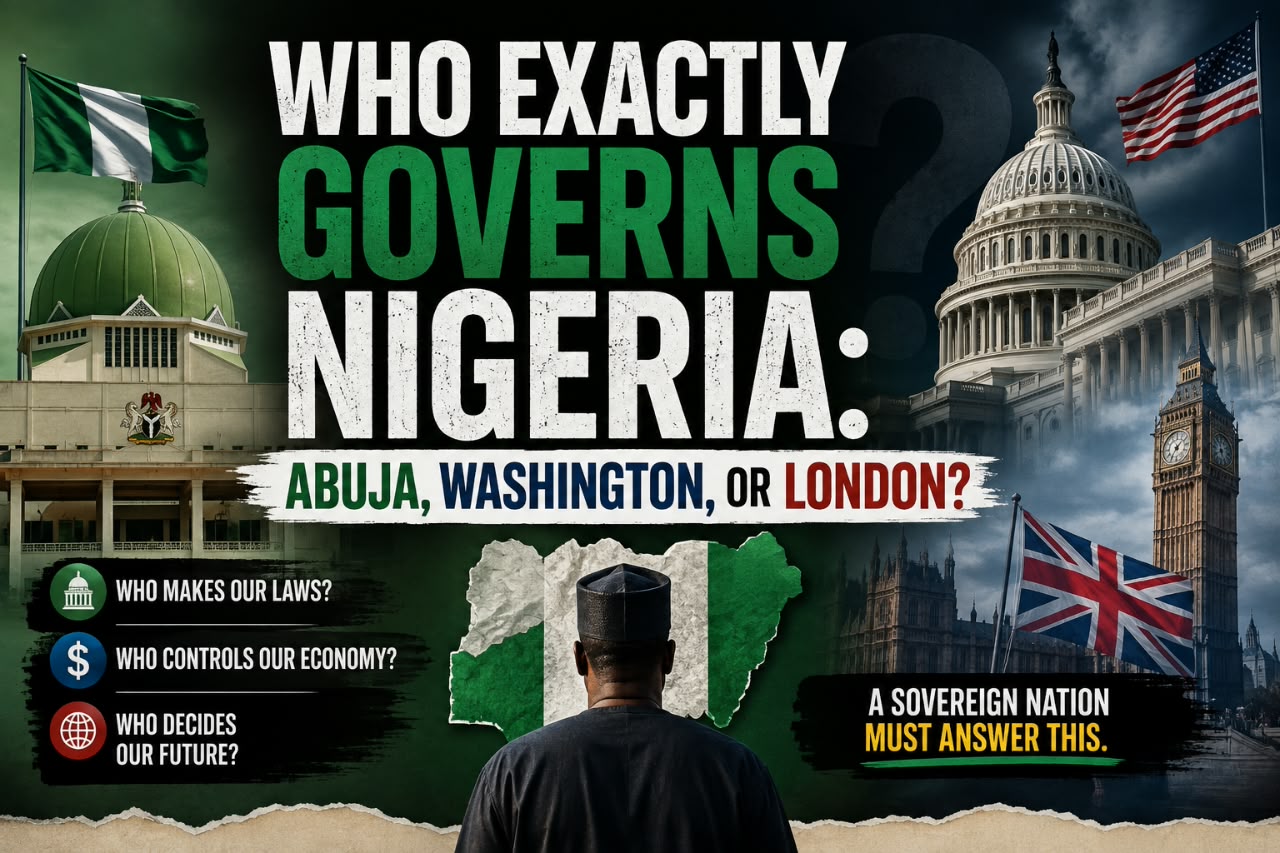
Nigeria needs to confront an uncomfortable question about its democracy and sovereignty: who governs Nigeria?
Nigeria remains Africa’s most populous country and one of its most influential political and economic powers. Yet, whenever major political disputes, corruption allegations or electoral controversies arise, many Nigerians quickly look beyond the country for answers.
Some turn to Washington. Others wait for the FBI. Some look to Britain or foreign courts for information and validation.
This raises a difficult question: who governs Nigeria — Abuja, Washington or London?
Foreign scrutiny and Nigeria’s political debates
Recent political controversies have brought the issue into sharper focus.
Former Vice President Atiku Abubakar and other opposition figures have called for the release of US records connected to President Bola Tinubu. The matter involves a US Freedom of Information Act case over records held by American law-enforcement agencies. The Presidency has maintained that the case concerns the release or withholding of records and does not amount to a criminal trial or conviction against Tinubu.
There was also another example in August 2026. Nigerian musician David Adeleke, popularly known as Davido, appealed to US President Donald Trump and the international community to pay attention to the Osun governorship election.
Davido cited concerns about possible violence, intimidation and disruption of the electoral process. He asked international actors to encourage Nigerian authorities to protect voters and respect their votes.
Seeking information from foreign institutions is not automatically wrong. International cooperation remains important when investigations involve several countries.
Evidence may be held abroad. Financial transactions may cross borders. Suspects may live outside Nigeria. Assets connected to investigations may also be located in foreign jurisdictions.
In such situations, Nigeria needs cooperation from other countries.
That is normal international law enforcement.
Cooperation is different from dependence
The real concern begins when Nigerians assume that domestic institutions cannot establish the truth without foreign intervention.
There is an important difference between international cooperation and national dependence.
Cooperation means Nigerian institutions investigate a matter and request assistance because part of the evidence lies outside their jurisdiction.
Dependence is different.
It occurs when citizens believe that Nigeria cannot investigate its own affairs, enforce its laws or establish facts unless another country acts first.
A sovereign country should be able to investigate its own affairs while working with foreign partners where necessary.
Nigeria can ask the United States for evidence. It can request assistance from Britain. It can work with international agencies on financial crimes and other cross-border offences.
But Nigerian institutions must still perform their own responsibilities.
Democracy cannot be outsourced
Foreign documents can contribute to political debates. They can provide evidence and raise questions that deserve investigation.
However, no foreign document should replace Nigeria’s democratic process.
The FBI is an American law-enforcement agency. It operates under US law and within the jurisdiction of the United States.
It is not Nigeria’s electoral commission.
American courts do not conduct Nigerian elections. The White House does not run Nigeria’s political system.
Ultimately, Nigerians choose their leaders through Nigeria’s constitutional and electoral processes.
That does not mean citizens should ignore information from abroad. It means such information should undergo proper scrutiny within Nigeria.
Facts should be examined. Evidence should be tested. Allegations should face due process.
Nigeria’s bigger problem is institutional trust
Nigeria has been independent since 1960. But political independence does not automatically create strong institutions.
A country can have a Constitution, elected leaders and independent institutions while citizens still place greater confidence in foreign organisations.
That situation can weaken public trust in domestic institutions.
When Nigerians believe local investigations are politically influenced, they may look elsewhere for answers.
When corruption cases appear selective, citizens may seek accountability outside the country.
When electoral institutions struggle to command public confidence, international observers may receive more attention than domestic institutions.
These problems point to a deeper issue: institutional trust.
Nigeria does not solve that problem simply by telling citizens to stop looking abroad.
Trust has to be earned.
Institutions must earn public confidence
Nigeria already has several institutions responsible for fighting corruption and protecting public accountability.
They include the Economic and Financial Crimes Commission, the Independent Corrupt Practices and Other Related Offences Commission, the Nigeria Financial Intelligence Unit, the Code of Conduct Bureau, the police, the courts and the National Assembly.
The bigger question concerns their independence and effectiveness.
Can these institutions investigate serving officials?
Can they pursue politically connected individuals?
Can they follow evidence when powerful interests are involved?
Can they operate without political pressure?
Those questions matter more than creating another institution.
Nigeria needs institutions that can perform their duties regardless of who holds political power.
Anti-corruption agencies should have sufficient operational independence. Investigations should follow evidence rather than political convenience. Prosecutions should not appear to target only political opponents.
The judiciary must also be able to resolve important cases within a reasonable period.
The real test of institutional independence is whether an agency can investigate the government currently in power, not only a previous administration.
The 2027 election and political responsibility
The same principle applies to Nigeria’s 2027 political contest.
Whether citizens support or oppose President Bola Tinubu, political parties must compete within Nigeria’s democratic framework.
Opposition parties can challenge government policies. They can criticise economic decisions and propose alternatives.
They can campaign on insecurity, unemployment, poverty and the cost of living.
They can organise at the grassroots and present candidates to voters.
That is the work of politics.
Foreign documents may add information to a political debate. But they cannot replace political organisation.
No foreign government can build a Nigerian political movement.
No international institution can create grassroots support for a political party.
And no foreign intervention can replace the responsibility of Nigerian politicians to persuade Nigerian voters.
Nigeria should welcome legitimate scrutiny
There are two extremes Nigeria should avoid.
The first is rejecting foreign scrutiny simply because it comes from outside the country.
That would be unrealistic. Crimes, financial transactions and assets can cross national borders. International cooperation is therefore necessary.
The second extreme is expecting foreign governments to solve problems that Nigerian institutions should handle themselves.
That creates dependence.
Nigeria needs cooperation without surrendering its political responsibility.
The United States, Britain and other countries can remain valuable partners. They can provide intelligence, assist investigations, support asset recovery and cooperate on extradition and other cross-border matters.
But Nigeria must also strengthen its own institutions.
So, who governs Nigeria?
The answer should remain clear: Nigeria’s affairs belong to Nigerians and must operate through the country’s constitutional institutions.
Foreign governments can provide evidence. Foreign courts can resolve matters within their jurisdiction. International agencies can assist Nigerian authorities.
But none of them should replace Nigeria’s democratic institutions.
Who governs Nigeria should therefore not be determined by which foreign institution releases a document or makes a statement.
The more important question is whether Nigeria has institutions strong enough to examine such information fairly when it arrives.
What happens after foreign records become available?
Will Nigerian agencies investigate credible allegations?
Will courts examine evidence according to law?
Will political parties present competing ideas?
Will voters have access to reliable information?
And will public institutions act without political interference?
Those questions will shape the strength of Nigeria’s democracy.
The FBI cannot fix Nigeria’s economy. Washington cannot conduct Nigeria’s elections. London cannot build Nigeria’s institutions.
Those responsibilities belong to Nigerians.
Sovereignty does not mean refusing international assistance. It means having the strength and institutional capacity to work with the world without depending on it to govern the country.
Nigeria needs credible institutions, confident citizens and a political culture that understands one simple principle: the world can assist Nigeria, but it cannot become Nigeria.
By Blaise Udunze