


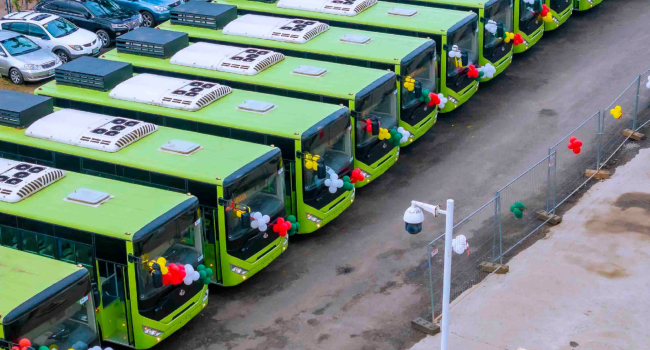
More Nigerian states are stepping up plans to deploy CNG buses and other alternative-energy vehicles as the Federal Government’s October 1 target for lower transport fares approaches.
Some states have already received vehicles, while others are awaiting deliveries, negotiating with private investors or preparing new transport plans.
President Bola Tinubu had directed state governments to speed up the deployment of Compressed Natural Gas (CNG) and electric mass transit systems. The aim is to achieve measurable reductions in transportation costs from October 1.
However, reports from across the country indicate that not all states may be ready by the deadline.
Federal Government expands CNG programme
The President said Nigeria must make greater use of its domestic gas resources rather than remain heavily exposed to international energy price movements.
According to the Federal Government, more than 120,000 vehicles have been converted to CNG, while over 400 certified conversion centres and more than 90 refuelling stations are operating across the country.
The Presidential Initiative on CNG and Electric Vehicles is also expanding its focus to electric mobility. The initiative is expected to support wider access to cleaner and cheaper transport options.
The latest rollout has seen several states introduce or prepare to introduce alternative-energy transport services.
Kano leads northern rollout
Kano State launched 222 CNG and electric vehicles earlier in the year as part of its public transportation programme.
At the launch, Vice President Kashim Shettima said the initiative was designed to reduce transportation costs and strengthen the country’s use of domestic gas resources.
He said high transport costs affect food prices, businesses, manufacturing and logistics.
Kano Governor Abba Yusuf described the programme as an important intervention because transportation plays a major role in the state’s commercial activities.
Private companies including Greenville LNG, AY Shafa, NIPCO, AA Rano and Rolling Energy are also investing in gas infrastructure in Northern Nigeria.
Akwa Ibom deploys 50 buses
Akwa Ibom State has deployed 50 CNG buses across its 31 local government areas.
The state Information Commissioner, Aniekan Umanah, said the buses were introduced to reduce the burden of transportation on residents following the removal of the petrol subsidy.
He said the state government was committed to improving movement across the state and using the alternative-fuel vehicles to make public transport more affordable.
Cross River receives 10 vehicles
Cross River State currently has 10 CNG-related vehicles for the initial phase of its programme.
The Commissioner for Transport, Kingsley Egomi, said the state had also started work on conversion centres.
He explained that the government was still assessing the full scope of the Federal Government’s intervention before announcing further details.
Abia targets 100 buses
Abia State plans to increase its fleet of government-backed alternative-energy buses to 100 by the end of the year.
Governor Alex Otti commissioned the first 20 buses last December, while another 20 were added recently.
The buses currently operate mainly in Umuahia and Aba, with plans to extend services to several inter-city routes.
The government-supported service between Umuahia and Arochukwu, for instance, charges about N2,000, compared with N5,000 charged by some private operators.
Benue orders more vehicles
Benue State says it is working to expand its public transport fleet.
The Chief Press Secretary to Governor Hyacinth Alia, Kula Tersoo, said the government had ordered additional buses, including CNG-powered vehicles.
He said the state had earlier procured 100 Toyota buses for Benue Links Nigeria Limited.
According to him, the arrival of the additional vehicles would enable the government to subsidise transportation and reduce fares for commuters.
Edo plans 50-bus rollout
Edo State is preparing to introduce 50 CNG buses into its public transport system.
Information and Strategy Commissioner Kassim Afegbua said the vehicles would be distributed across the state’s three senatorial districts and 18 local government areas.
He said the government expected the buses to operate at very low fares, which could also pressure private transport operators to reduce their charges.
The buses are scheduled for unveiling on October 15, with First Lady Oluremi Tinubu expected to perform the ceremony.
Delta awaits 50 buses
Delta State is expecting 50 CNG-powered buses for the pilot phase of its MORE Mass Transit Scheme.
Commissioner for Transport Onoriode Agofure said the state was constructing terminals in Asaba and Warri ahead of the arrival of the vehicles.
The buses are expected to provide both inter-city and intra-city services.
The state’s assessment of transport patterns in seven major cities found that about 80 per cent of residents rely on public transportation.
The pilot fleet is therefore expected to support workers, students, traders and other commuters.
Ondo requests 100 buses
Ondo State has requested 100 CNG buses and another 100 CNG-powered tricycles from the Federal Government.
The Special Adviser to Governor Lucky Aiyedatiwa on Transport, Muyiwa Ogunyemi, said the request followed a meeting involving state transport commissioners, the Presidential Implementation Committee on CNG and Electric Vehicles and the Nigeria Governors’ Forum.
He stressed that the number requested was not guaranteed.
Ogunyemi also said the success of the programme should be measured by its effect on commuters, rather than simply the number of vehicles acquired.
Ondo is also working with private companies on conversion facilities and CNG infrastructure.
The state already has a CNG facility in Ore but will need additional infrastructure if adoption increases.
Lagos still in talks with FG
Lagos State is yet to announce its full plan for the Federal Government’s October 1 transport-fare target.
Information and Strategy Commissioner Gbenga Omotoso said the state supports efforts aimed at improving the living conditions of residents but did not provide details on the planned intervention.
Ebonyi, Imo, Anambra, Ogun and Osun are also still working out their respective arrangements.
Imo, Anambra and Ogun prepare plans
Imo State said it had revived the Imo Transport Company and was also exploring greater use of CNG-powered vehicles.
The state already provides free transport for civil servants and is considering further measures to lower commuting costs.
At the Federal University of Technology, Owerri, CNG-compatible buses and tricycles are also being prepared for use within the university community.
In Anambra, Transport Commissioner Edward Obiefuna Ibuzo said the government was discussing partnerships with private investors.
He also disclosed that the state had trained 1,000 youths through a skills programme focused on electric vehicles and clean-energy technologies.
The state is also engaging Innoson Motors as it works towards unveiling its own transport plan.
Ogun State, meanwhile, is expanding the use of CNG and electric vehicles.
The state government says the programme will help reduce fuel and operating costs for transport operators while supporting cleaner mobility.
Osun awaits Federal Government team
Osun State is expecting a Federal Government delegation to help finalise plans for the CNG transport programme.
Commissioner for Transportation Sesan Oyedele said the state had already prepared a blueprint for reducing transport fares.
He noted, however, that effective fare regulation would depend heavily on the availability of alternative-energy buses because of the high cost of conventional fuel.
Read Also: FG Cuts Late Tax Interest From October 1:late-tax-interest-fg-cuts-rate
Kaduna offers free transport
Kaduna State has already been operating a free mass transit programme using CNG buses supplied through the Federal Government initiative.
Information and Culture Commissioner Ahmed Maiyaki said the programme began in July 2025 and initially focused on civil servants, retirees and students.
It was later expanded to other commuters on designated routes.
The state said about 3.2 million passengers had benefited from the service, with commuters saving an estimated N3.5 billion.
About 30 buses currently operate daily, serving around 200 bus stops between 7am and 6pm.
The government is also constructing 200 modern bus stops.
The free mass transit programme is separate from the Kaduna Bus Rapid Transit project, which is being developed as a longer-term urban transport system.
Other states yet to announce details
Niger, Nasarawa and Katsina states had not disclosed detailed plans at the time of the latest reports.
Kogi State, however, plans to meet with the state chapter of the National Union of Road Transport Workers to discuss the issue.
The discussions are expected to form part of the state’s preparations for implementing the Federal Government’s transport-cost reduction directive.
NADDC begins technician training standards
As states expand their use of alternative-energy vehicles, the National Automotive Design and Development Council has started validating training manuals for technicians working on CNG and electric vehicles.
The manuals are designed to standardise the training and certification of technicians who install, maintain, diagnose and repair the vehicles.
NADDC said the exercise would ensure that technicians have the practical skills needed to handle technologies such as high-pressure gas systems, high-voltage electric vehicles and battery systems safely.
The council also said the transition could create opportunities for job creation, skills development, technology transfer and local manufacturing.
Experts involved in the validation exercise are reviewing areas including technical content, practical exercises, safety procedures, learning outcomes and assessment methods.
The Automotive Sector Skills Council also stressed the need for practical training as Nigeria’s automotive sector adopts alternative-energy vehicles.
With October 1 approaching, the pace of implementation will determine how widely commuters begin to see lower transport costs across the states.