


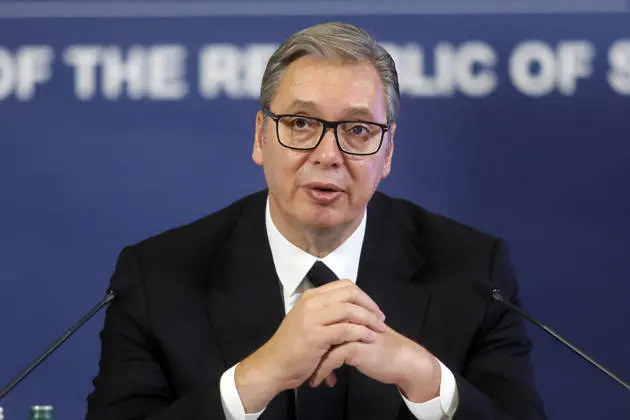
Serbia’s President Aleksandar Vučić has resigned from office, paving the way for presidential elections following more than a year of student-led protests and growing public anger over alleged government corruption.
Vučić announced his resignation while addressing supporters outside the presidential building in Belgrade. He defended his nine-year leadership, saying his administration had maintained peace and stability in the country.
Vučić steps down amid protests
The Serbian president had announced in June that he planned to leave office.
Under Serbia’s constitution, Vučić cannot seek a third presidential term. His resignation means a presidential election must now take place within three months.
Parliamentary elections are also scheduled to take place earlier, with the vote expected in late October.
The parliamentary election was brought forward after months of protests, with demonstrators adding early elections to their demands.
Railway station collapse sparked protests
Public anger against the government intensified after the roof of a railway station in Novi Sad collapsed in 2024, killing 16 people.
The disaster triggered protests involving students, teachers, workers and farmers.
Demonstrators accused the authorities of failing to properly oversee the station’s renovation. The project had been presented as a symbol of Serbia’s development.
Several officials resigned during the crisis, but the changes failed to end the demonstrations.
Protests continued into the summer and later became more tense following allegations of police brutality.
Brnabić to serve as interim president
Parliamentary Speaker Ana Brnabić, a member of Vučić’s Serbian Progressive Party, will serve as interim president until a new head of state is elected.
Vučić has also indicated that he intends to remain active in Serbian politics.
He is expected to seek a leading role in the upcoming parliamentary election, raising the possibility that he could retain significant political influence after leaving the presidency.
The former president also used his constitutional powers to pardon 49 people, including 23 students and members of his party, according to Serbia’s public broadcaster RTS.
Three groups prepare for parliamentary vote
The upcoming parliamentary election is expected to feature Vučić’s Progressive Party, the student-led anti-corruption movement Students Win and a coalition of pro-Western opposition parties known as European Serbia.
Vučić has been a major figure in Serbian politics for more than a decade.
He became prime minister in 2014 before winning the presidency in 2017.
During his time in government, he has supported Serbia’s ambition to join the European Union while maintaining close relations with Russia and encouraging Chinese investment in the country.