



An Exclusive Interview with Mr. Sunni Otegwu, Chief Business Development Officer, Panoramic Synergy Enterprises Ltd (PSE)
Artificial Intelligence is no longer a future prospect — it is the defining force reshaping how organizations operate, compete, and serve people today. From healthcare diagnostics to financial decision-making, AI systems are being embedded into the most consequential processes of our time.
Yet for all its promise, AI carries serious risks: opaque decision-making, embedded bias, data misuse, and accountability gaps that can erode public trust in an instant.
The question facing every board, every executive, and every technology leader is not whether to adopt AI — that decision has largely been made for them. The real question is whether they are building and deploying AI responsibly enough to withstand scrutiny, earn trust, and deliver lasting value.
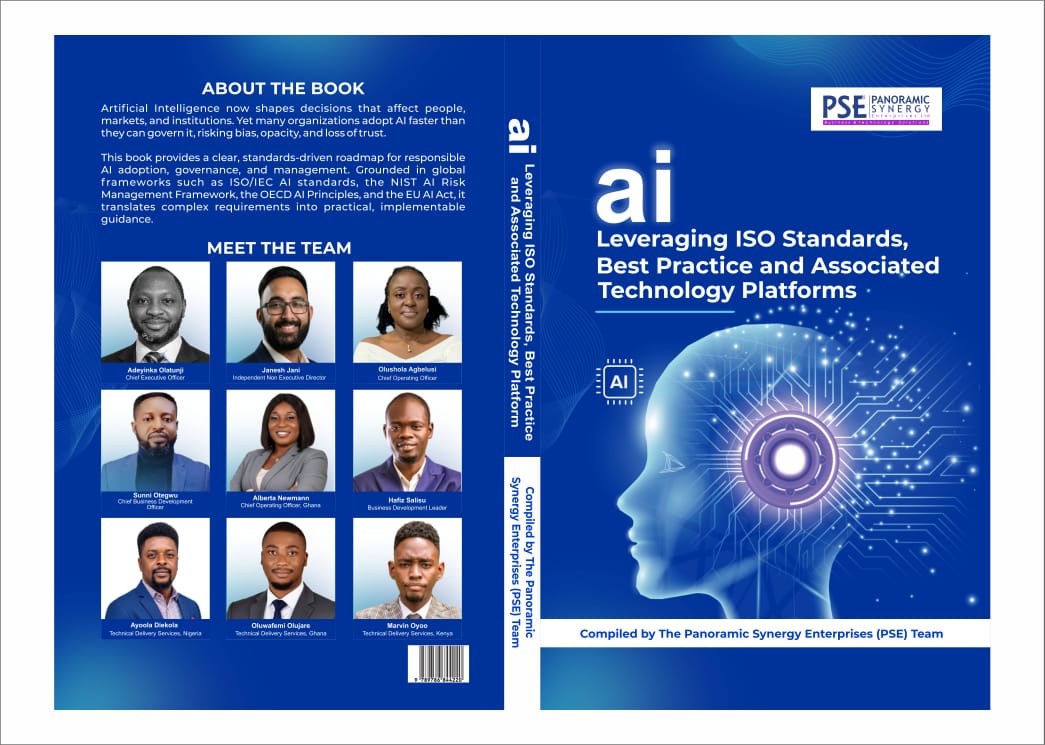
Panoramic Synergy Enterprises Limited (PSE), a leading advisory firm in AI governance, cybersecurity, and ISO standards implementation, has produced a timely and practical resource to help organizations answer that question. Their new book, AI Leveraging ISO Standards, Best Practice and Associated Technology Platforms, offers a structured roadmap for responsible AI adoption, grounded in globally recognized governance frameworks. In this exclusive interview, PSE’s Chief Business Development Officer, Mr. Sunni Otegwu, unpacks the book’s core arguments and explains why governance is the missing ingredient in most AI strategies.
“AI is not just about intelligence — it’s about responsibility.”
Q: What is the central message of this book?
The core message is simple but powerful: AI is transforming every sector, but its success depends on strong governance, ethical standards, and high-quality data. At PSE, we emphasize that AI must be developed responsibly using globally recognized frameworks — particularly ISO standards — to ensure fairness, transparency, and trust.
Q: Why are global AI standards important?
Global standards provide a common language for building and managing AI systems. Through our work at PSE, we’ve seen how these standards help organizations reduce risks, ensure safety, and align innovation with critical human values like accountability and fairness.
For example, banks in Nigeria such as GTBank, Access Bank, Zenith Bank, and UBA are increasingly adopting AI for fraud detection and credit scoring. However, without standards, these systems can unintentionally create risks such as biased lending decisions or weak fraud detection accuracy.
Q: How does the book define Artificial Intelligence?
The book defines AI as systems capable of acquiring, processing, and applying knowledge to achieve specific goals. It’s not about replacing humans — it’s about solving problems intelligently and efficiently, a principle we embed in all our advisory services at PSE.
Q: What are the key benefits of AI for organizations?
AI delivers three major advantages: Automation, Augmentation, and Innovation. At PSE, we help organizations unlock these benefits while maintaining compliance and ethical integrity.
For example, Nigerian banks using AI for customer service chatbots reduce operational costs while improving customer response times.
Q: What is the AI value chain?
It is the complete lifecycle of an AI system — from data collection and preparation, through model training and deployment, to continuous monitoring and improvement. This lifecycle approach ensures AI systems remain accurate, relevant, and ethical, which is central to how PSE frames its consulting and implementation engagements.
Q: What is ethical AI and why is it critical?
Ethical AI ensures systems are fair, transparent, accountable, and respectful of human rights. Without it, AI can reinforce bias, invade privacy, and cause broader societal harm. That is why PSE places ethics at the heart of every AI and cybersecurity engagement we undertake.
Q: How can organizations manage AI risks effectively?
Organizations should adopt structured governance frameworks, conduct regular ethical audits, and align with international standards. At PSE, we support clients with AI risk management frameworks, compliance strategies, and continuous monitoring systems designed to keep risk visible and manageable.
By implementing AI governance frameworks, Nigerian banks can reduce fraud losses while increasing customer confidence and regulatory compliance.
Q: What role does governance play in AI?
Governance ensures accountability, compliance, and ethical usage. It defines responsibilities for data, models, and decisions — ensuring alignment with regulations and business objectives. Governance is not an afterthought; it is the foundation. It sits at the core of everything PSE delivers.
Q: What is AI maturity and why does it matter?
AI maturity reflects how advanced an organization is in its AI journey. We typically see four stages: Awareness, Experimentation, Integration, and Optimization. PSE helps organizations honestly assess where they are and build a structured path forward to achieve sustainable AI transformation.
Q: How can AI benefit society?
When responsibly implemented, AI has the potential to improve healthcare outcomes, enhance education access, boost agricultural productivity, protect the environment, and drive broad economic growth. That is the vision PSE promotes — AI as a force for inclusive and sustainable development, not just competitive advantage.
Q: What is the future outlook for AI?
The future depends entirely on how well we balance innovation with responsibility. Organizations that invest now in ethical practices, global standards compliance, and human-centered design will be the ones that earn lasting trust. That balance is what the book advocates, and it is what drives PSE’s advisory work.
Q: What is the book’s final call to action?
The book urges governments, businesses, and professionals to adopt ISO/IEC 42001:2023 — the AI Management System standard — as a practical starting point. Beyond that, it calls for AI solutions that are secure, explainable, and reliable, so users can genuinely trust their outputs and organizations can deploy them with confidence in high-stakes decisions.
Q: A final word for the audience?
Artificial Intelligence is no longer optional — it is inevitable. The real question is not whether organizations will adopt AI, but how responsibly they will do so. This book provides a practical roadmap for building AI systems that are not only intelligent but ethical, secure, and worthy of public trust.
About Panoramic Synergy Enterprises Limited (PSE)
Panoramic Synergy Enterprises Limited (PSE) is a leading consultancy specializing in AI governance, cybersecurity, ISO standards implementation, IT strategy, and risk management. With a strong commitment to excellence and ethical integrity, PSE helps organizations navigate digital transformation while maintaining compliance, security, and accountability.
Get the Book: AI Leveraging ISO Standards, Best Practice, and Associated Technology Platforms is essential reading for executives, policymakers, and professionals seeking to harness AI responsibly.