


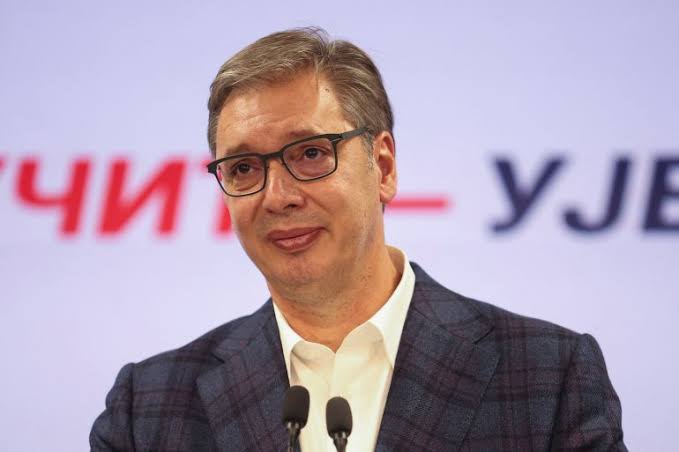
Serbian President Aleksandar Vučić has conceded defeat in snap parliamentary elections after a student-led political movement defeated his ruling party following nearly two years of protests against his government.
The Student List secured a projected 135 to 140 seats in Serbia’s 250-member parliament, compared with 105 seats for Vučić’s Serbian Progressive Party (SNS), according to preliminary vote estimates cited in the report.
Vučić acknowledged the loss while addressing supporters after Sunday’s election. The vote also recorded the highest voter turnout in more than three decades.
The result marks a major turning point in Serbian politics for a leader who has dominated the country’s political landscape for more than a decade.
How Student Protests Challenged Vučić
The movement that eventually challenged Vučić’s government emerged after a concrete canopy collapsed at a railway station in Novi Sad on November 1, 2024, killing 16 people.
The tragedy triggered widespread public anger and demonstrations over alleged corruption, accountability and failures in public institutions. Students led the protests, which later attracted university lecturers, doctors, workers and other members of society.
The campaign eventually developed into the Student List, a political platform that promised to tackle corruption, reduce political interference in public institutions and restore citizens’ rights.
Ilija Srdanović, a professor at the Faculty of Medicine in Novi Sad, led the movement during the election campaign.
Vučić dismissed the protesters as “blockaders” and accused them of attempting to destabilise Serbia. However, the movement continued to gain support as dissatisfaction with the government grew.
Vučić’s Rise From Nationalist Politics to Power
Born in Belgrade in 1970, Vučić studied law at the University of Belgrade before entering politics in 1993. He joined the Serbian Radical Party, a nationalist political organisation led by Vojislav Šešelj.
His political record during the 1990s included hardline nationalist rhetoric. In July 1995, shortly after the Srebrenica genocide, Vučić made a widely cited statement threatening retaliation against Muslims if Serbs were killed.
Šešelj, his political mentor at the time, was later sentenced in 2018 by an international appeals chamber for crimes including persecution, deportation and forcible transfer of non-Serbs during the Balkan wars.
Vučić later broke away from the Serbian Radical Party. In 2008, he joined Tomislav Nikolić in founding the Serbian Progressive Party, which sought to move closer to mainstream European politics.
The party rose to power in 2012 on promises to fight corruption, organised crime and abuses associated with previous administrations.
One high-profile case involved businessman Miroslav Mišković and his son Marko, who were arrested in December 2012 over suspected financial irregularities and tax evasion. Following years of legal proceedings, both were acquitted, and the state paid them compensation.
Serbian journalist Safeta Biševac told Al Jazeera that the government’s anti-corruption campaign produced limited results while political control over public institutions, the media and wider political life expanded.
From Prime Minister to Serbia’s President
Vučić served as first deputy prime minister from 2012 to 2014 before becoming prime minister in 2014. He won the presidency in 2017 and secured another term in 2022.
Although his presidential term was scheduled to run until 2027, sustained protests placed his government under growing pressure. According to the report, he resigned in September and called early parliamentary elections.
Despite constitutional limits on presidential power, Vučić maintained significant influence over his party and government policy.
Biševac argued that he had made numerous promises but delivered relatively few, while consolidating considerable control over the state apparatus.
Serbia’s Economic Growth Failed to Silence Critics
Serbia recorded substantial economic growth during Vučić’s years at the centre of government, according to official figures cited by Reuters.
Unemployment fell from around 26 per cent in 2012 to between 8 and 9 per cent. The country’s nominal gross domestic product nearly tripled to approximately €90 billion.
Foreign direct investment also increased considerably. Annual inflows rose from about €800 million in 2012 to a record €5.2 billion in 2024. Serbia also expanded its motorway network.
However, economic progress did not eliminate concerns about living standards. Rising prices and public debt remained important issues in debates about the government’s performance.
Political scientist Duško Radosavljević said the student movement had given a voice to citizens’ legitimate frustrations.
He also criticised what he described as sustained pressure on social institutions, alleging that state intelligence services focused excessively on monitoring political opponents while critical debate received less space in public media.
Student Movement Signals a New Political Era
The election result represents a significant challenge to the political structure Vučić built over more than a decade.
What began as public anger following a deadly infrastructure disaster developed into a broader movement demanding accountability, institutional independence and political change.
The Student List’s projected parliamentary majority signals the scale of that challenge. Its ability to fulfil its promises on corruption, public institutions and citizens’ rights will now be central to Serbia’s political future.