


Ukraine has claimed responsibility for a major naval attack on Russian military assets in North Africa, sinking a warship in Libya and disabling a cargo vessel suspected of transporting weapons for Moscow.
Ukrainian President Volodymyr Zelensky announced the strikes on Monday, describing them as another successful operation against Russian military interests far beyond the main battlefields of the ongoing war.
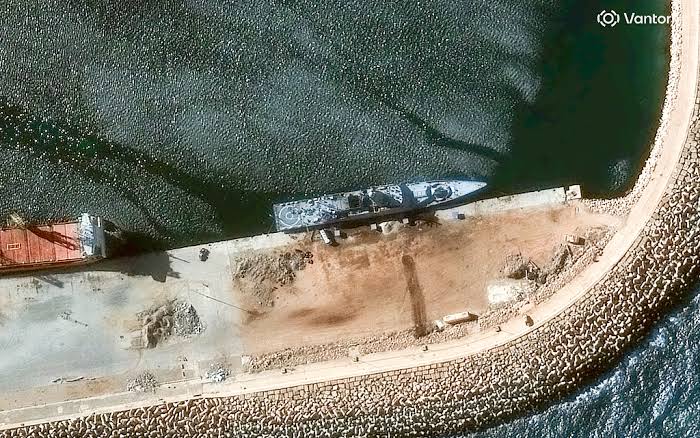
The attack targeted the Russian naval corvette Merkury, which was docked in Benghazi, eastern Libya. Zelensky said Ukrainian forces deployed seven maritime drones to destroy the vessel.
According to the Ukrainian leader, the operation also destroyed a combat helicopter aboard the warship.
Footage released by Zelensky showed Ukrainian sea drones approaching the vessel before a massive explosion engulfed it at the port. Satellite images from imagery company Vantor later showed the ship submerged.
The 344-foot warship, weighing approximately 1,800 tonnes, was among Russia’s newer naval vessels. It reportedly arrived in Benghazi to refuel under a maritime cooperation agreement before returning to Russia.
Russia’s state news agency, TASS, previously reported that the vessel featured advanced technologies designed to reduce its visibility to enemy radar. The Merkury joined the Russian fleet in May 2023.
Ukraine also targeted the MV ANGARA, a cargo ship that Zelensky accused Russia of using to transport weapons.
Ukraine’s intelligence agency said the maritime drones reached their designated positions before launching from a so-called mothership.
Russia had not publicly commented on the reported attacks at the time of the announcement.
The strikes followed another suspected Ukrainian drone attack on a Russian cargo vessel in the Baltic Sea, approximately 2,000 miles away.
Libya caught in expanding Russia-Ukraine conflict
The attack has highlighted the growing reach of the Russia-Ukraine war, with military operations increasingly extending beyond Europe’s main battlefields.
Ukraine has reportedly expanded its activities across parts of Africa, including Libya, Mali, Chad, Niger, Sudan and Burkina Faso, as Kyiv attempts to challenge Moscow’s growing influence on the continent.
Libya has become an important strategic location because of its oil resources and prolonged political instability.
The country remains divided between two rival administrations. The UN-backed Government of National Unity controls western Libya from Tripoli, while the Government of National Stability exercises authority in the east.
A Ukrainian naval drone operator previously told CNN that his unit used a military base in Misrata as a launch point for operations against Russia’s shadow fleet in the Mediterranean.
He said the activities also involved training local forces.
Following the destruction of the Merkury, Libya’s Government of National Stability announced a joint investigation with Russia.
The administration stressed that Libya was not involved in the Russia-Ukraine conflict and would not allow its territory to become an arena for settling international disputes.
Second Russian vessel hit in separate attack
While the attack unfolded in Benghazi, emergency responders were battling a fire aboard another Russian cargo vessel in the Baltic Sea.
The Finnish military said suspected Ukrainian drones had struck the Sparta II a day earlier.
Firefighting teams from Finland, Russia and Estonia joined efforts to contain the blaze, creating an unusual situation in which Russia and two NATO members worked together during the ongoing conflict.
The latest incident adds to Russia’s growing naval losses since its invasion of Ukraine.
The Merkury joins approximately 40 other Russian naval vessels reportedly lost during the war. Among the most significant losses was the guided-missile cruiser Moskva, the flagship of Russia’s Black Sea Fleet, which Ukraine sank in April 2022.
Naval analyst Carl Schuster told CNN that protecting warships stationed in foreign ports presents serious challenges.
He explained that the host country bears responsibility for the physical security of foreign naval vessels while they remain in its ports.
Schuster also noted that warships face restrictions when responding to suspected attacks in foreign territory, as they must establish that an actual threat exists before engaging an enemy.
He suggested that Ukraine’s merchant fleet could provide seemingly ordinary platforms for launching maritime drone operations.
Schuster described the developments as evidence of a new era of unconventional maritime warfare, with naval attacks increasingly extending into locations far removed from traditional battle zones.