


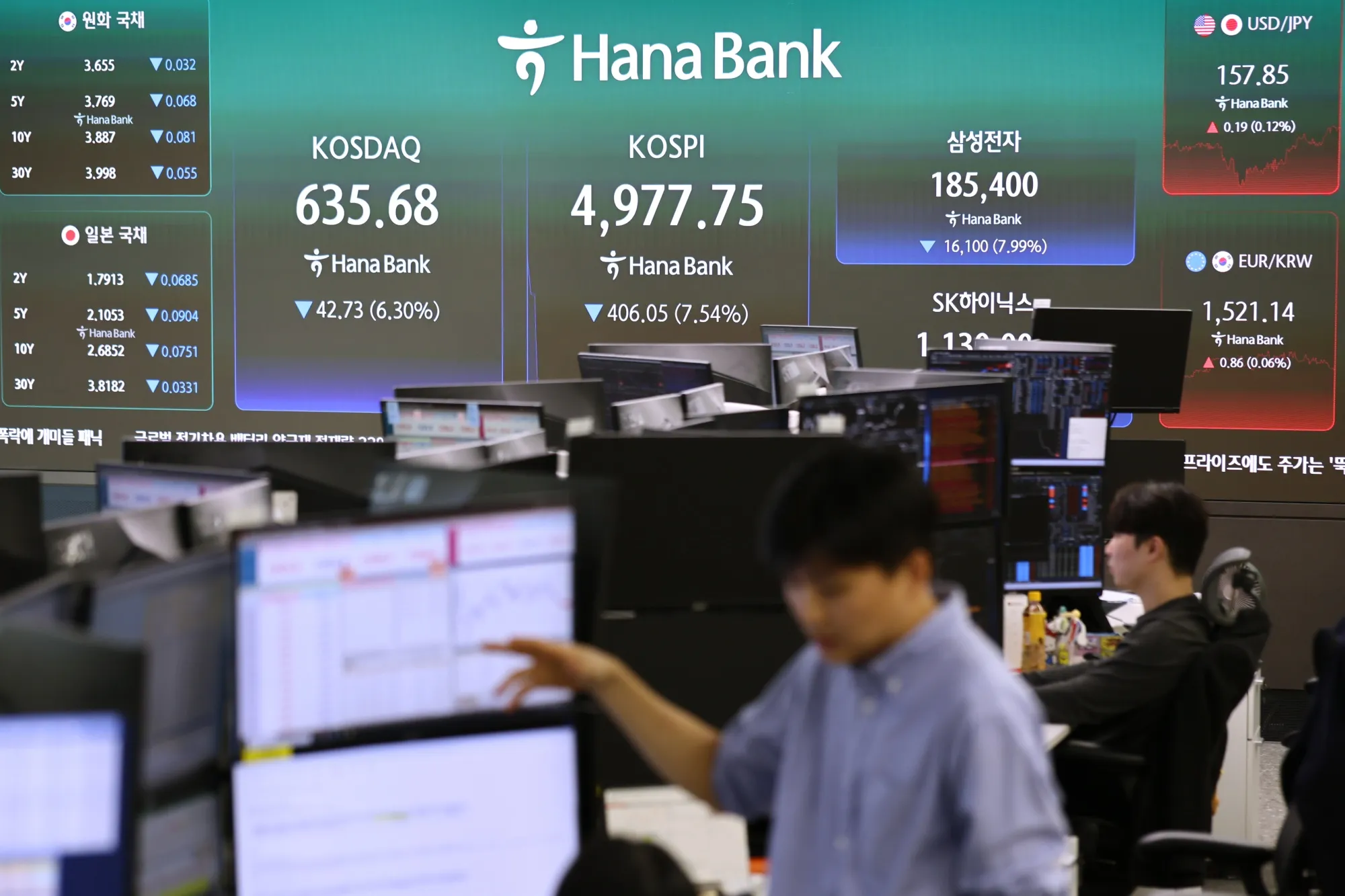
The global technology sector is facing renewed pressure as fears of an artificial intelligence (AI) investment bubble trigger heavy losses across major Asian stock markets.
Investors in South Korea and Hong Kong extended Friday’s technology-led sell-off on Monday, as concerns grew over whether major technology companies can sustain their massive spending on AI infrastructure.
The latest market downturn has increased uncertainty about the future of the AI boom, which has attracted trillions of dollars in investment from technology firms worldwide.
Asian stock markets recorded mixed performances, with South Korea’s benchmark Kospi suffering the biggest losses among the major indices.
The Kospi dropped as much as 5.8 per cent during trading before closing 3.3 per cent lower. Major semiconductor manufacturers Samsung Electronics and SK Hynix also declined by 3.1 per cent and 2.5 per cent, respectively.
Both companies play major roles in the global AI industry as the world’s leading memory chip manufacturers.
Hong Kong’s Hang Seng Index fell 0.1 per cent after losing nearly 2 per cent earlier in the session. Meanwhile, China’s CSI 300 recovered from an initial decline of more than 1 per cent to close 0.1 per cent higher.
Taiwan’s Taiex also reversed its early losses, finishing the session 2.2 per cent higher. Japan’s stock market remained closed for Labour Thanksgiving Day.
The latest weakness followed a difficult session on Wall Street on Friday. The S&P 500 dropped 3.7 per cent, while the technology-heavy Nasdaq Composite plunged 5.3 per cent.
The Nasdaq’s decline wiped out all its gains for 2026. Technology stocks, particularly companies associated with artificial intelligence, accounted for much of the losses.
South Korea’s Kospi, Japan’s Nikkei 225 and Taiwan’s Taiex had also suffered significant losses before the weekend, closing between 5.1 per cent and 6.2 per cent lower. Hong Kong’s Hang Seng ended Friday’s session down 1.9 per cent.
However, US stock futures pointed towards a possible recovery when Wall Street reopened on Monday. Futures linked to the S&P 500 and Nasdaq rose 2.2 per cent and 2.9 per cent, respectively.
Rajat Agarwal, an Asia equity strategist at Societe Generale, said investors were trying to determine whether the recent correction had gone too far.
He described Friday’s technology sell-off in the United States as an unusually severe market event, adding that investors were searching for stability after the sharp losses.
AI investment boom raises market concerns
The latest downturn reflects growing concerns about the enormous sums technology companies are spending to develop artificial intelligence.
Investors are questioning whether these companies can generate enough returns to justify their multi-trillion-dollar investments in data centres, advanced chips and other infrastructure required to train and operate AI systems.
Technology research firm Gartner estimates that global AI-related investment will reach $2.7 trillion in 2026 before climbing to $3.6 trillion in 2027.
However, the heavy reliance on borrowed funds to finance these projects has raised fears of a possible market bubble.
Some investors believe the current excitement surrounding artificial intelligence could resemble the dot-com boom of the late 1990s, which ended in a major market crash in 2000.
Regulatory concerns have also added pressure to the sector. Expectations that the Democratic Party’s victory in the US midterm elections could slow data centre construction in several states have contributed to market uncertainty.
Meanwhile, an alleged espionage scandal involving Nvidia and its former chief executive, Jensen Huang, has intensified calls for tighter restrictions on China’s access to advanced semiconductor technology.
Khoon Goh, head of Asia research at ANZ, said concerns surrounding artificial intelligence would remain a major influence on market movements this week.
He noted that investors were watching closely for signs that the recent sell-off had reached its lowest point.
Despite the uncertainty, Goh identified some positive developments. US equity futures had recovered, while South Korea reported a strong increase in semiconductor exports during the first 20 days of November.
The country’s semiconductor exports surged 294.4 per cent year-on-year, offering some reassurance about continued demand for technology products.
For now, investors remain cautious as they assess whether the massive AI investment boom can support the high valuations of technology companies.