


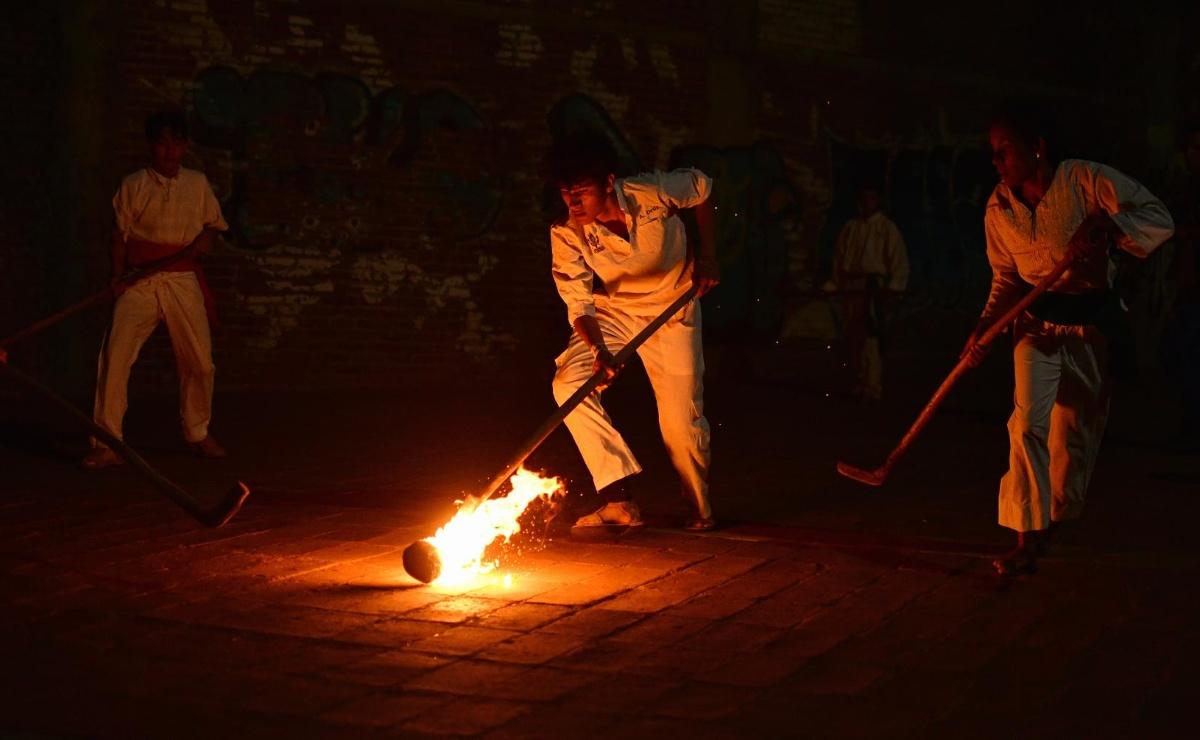
An ancient Mexican sporting tradition dating back more than 3,500 years has attracted international attention at the Ethnosport Culture Festival in Riyadh, Saudi Arabia.
The traditional sport, known as P’urepecha Ball, fascinated visitors at the cultural event, which brought together traditional games and sporting practices from different parts of the world.
The festival marked the first time the event was held outside Türkiye, giving the Mexican team an opportunity to showcase its Indigenous sporting heritage to an international audience.
The P’urepecha Ball game originated around 1500 BC among Indigenous communities in what is now Michoacan State, Mexico.
How the Ancient P’urepecha Ball Game Is Played
The traditional sport is played on a field measuring approximately 120 metres long and between six and eight metres wide.
Each team consists of six to eight players who use specially designed wooden sticks to strike a ball. The sticks have curved lower ends, making them similar to hockey sticks.
Also known as Uarhukua Ch’anakua, the game belongs to the hockey family and has survived for centuries through the oral traditions of local communities.
Manuel Sanchez, leader of the Mexican team, described the opportunity to represent his people at the Saudi festival as a significant experience.
He told Anadolu that the event was helping the sport gain recognition beyond Mexico.
Sanchez said showcasing the tradition abroad demonstrated the importance of protecting Indigenous culture and passing it on to future generations.
He also identified Michoacan as the birthplace of the sport, noting that some of its earliest archaeological traces were discovered around Cerro de los Penoles.
The discoveries reportedly include depictions of people playing with sticks and spectators watching the activity.
Fire Performance Captivates Festival Visitors
One of the biggest attractions of the Mexican team’s appearance was a special performance involving a ball set on fire.
Sanchez said visitors were particularly surprised by the unusual display, which carries cultural and spiritual significance for the Indigenous community.
He explained that the performance celebrates life while paying tribute to death, reflecting important elements of Mexican cultural beliefs.
According to him, the tradition also honours Curicaveri, a deity associated with the team’s cultural heritage.
Sanchez explained that fire and the sun hold special significance in their culture, making the performance an expression of respect for these elements.
Mexican Team Takes Ancient Sport Across Borders
Sanchez, who has practised the sport for 21 years, said the team had participated in several international cultural events.
Among them was the fourth World Nomad Games, held in Iznik, Türkiye, in 2022.
The team also attended Brazil’s first Indigenous Peoples’ Gathering and participated in Italy’s Tocatì Festival in 2012 and 2014.
He credited the Mexican Federation of Indigenous and Traditional Games and Sports, alongside its president, Ana Claudia Collado Garcia, for supporting the team’s international appearances.
Sanchez encouraged people interested in the sport to follow the federation’s official online platforms for more information.
Saudi Festival Showcases Global Cultural Heritage
The Ethnosport Culture Festival forms part of Riyadh Season, a major entertainment initiative linked to Saudi Arabia’s Vision 2030 programme.
Riyadh Season seeks to strengthen the Saudi capital’s position as an international tourism and entertainment destination.
Its activities include sporting competitions, concerts, cultural exhibitions, food festivals and other entertainment programmes.
This year’s Ethnosport festival brought together traditional sports and cultural practices from different countries, giving visitors an opportunity to experience sporting traditions that have survived across generations.
The appearance of the Mexican team offered a rare opportunity to introduce the ancient P’urepecha Ball game to a wider international audience.