


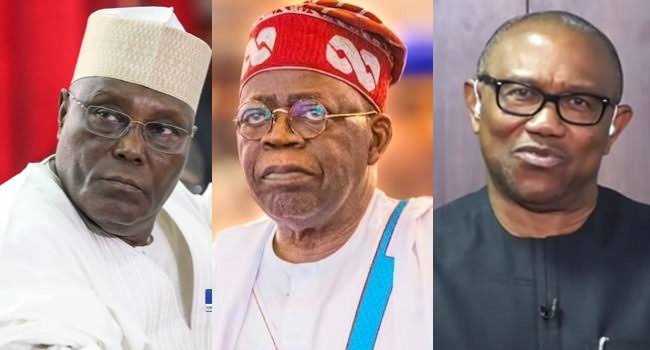
Opposition coalition against Tinubu has faced fresh uncertainty ahead of the 2027 presidential election after former Vice President Atiku Abubakar and Peter Obi failed to attend a key summit in Abuja.
Seven opposition parties reportedly gathered in the Federal Capital Territory on Monday under the G-100 platform to discuss plans to strengthen cooperation ahead of the 2027 general election.
The meeting was expected to advance efforts to build a united opposition front capable of challenging President Bola Tinubu and the ruling All Progressives Congress (APC).
However, the absence of Atiku and Obi, two of the most prominent figures associated with the opposition, has raised fresh questions about whether the coalition can overcome internal disagreements and agree on a common political strategy.
Their running mates were also reportedly absent from the summit.
Opposition Coalition Against Tinubu Faces Fresh Setback
The latest meeting was another attempt to bring Nigeria’s opposition forces together ahead of the 2027 election.
The G-100 initiative is focused on creating a broader opposition alliance, with discussions including the possibility of eventually producing a single presidential candidate to challenge Tinubu.
However, the absence of some major political figures has highlighted the difficulty of building consensus among the different parties and presidential hopefuls.
A previous opposition gathering held in Ibadan on April 25 also failed to produce the level of unity expected, with Oyo State Governor Seyi Makinde reportedly absent from the summit he hosted.
Read Also:https://e247mag.com/nigerias-money-s…tight-cbn-policy/
APC Dismisses Opposition Coalition Plans
The ruling APC has dismissed the opposition’s efforts to form a united front against Tinubu, arguing that competing ambitions among the opposition leaders could prevent them from agreeing on a single candidate.
APC National Secretary Senator Ajibola Basiru questioned whether the opposition parties could successfully settle on one presidential candidate.
Basiru also described the Abuja gathering as being of limited political significance, suggesting that personal ambitions could undermine the coalition.
APC National Publicity Secretary Felix Morka also criticised the development, pointing to the absence of Atiku and Obi as evidence that the opposition’s unity project was already facing difficulties.
Reno Omokri Speaks on Atiku, Obi
Former presidential aide and Nigerian Ambassador-designate to Mexico, Reno Omokri, also expressed doubts about the possibility of a successful opposition alliance.
Omokri argued that the leading presidential contenders would struggle to withdraw their ambitions in favour of one another.
“Peter Obi is not going to step down for Waziri Atiku Abubakar. Waziri Atiku Abubakar is not going to step down for Peter Obi. None of those people is going to step down for the other. So, it’s dead on arrival,” he said.
According to Omokri, the coalition would face its biggest test when discussions move from general cooperation to the contentious question of who should emerge as its presidential candidate.
ADC Clarifies Opposition Coalition’s Goal
The African Democratic Congress (ADC), however, offered a more measured assessment of the G-100 discussions.
ADC National Publicity Secretary Bolaji Abdullahi said the talks were not solely focused on producing a single presidential candidate.
He said the emergence of one candidate would be welcomed if the discussions eventually led to that outcome, but insisted that it was not the primary objective of the coalition.
“If it will lead to a situation where we have a single presidential candidate, it will be fine. But that is not the main objective of the conversation,” Abdullahi said.
The statement suggests that the opposition alliance is also considering broader areas of cooperation beyond the selection of a joint presidential candidate.
Read Also:https://e247mag.com/atiku-1-2m-lobbying-gamble-exposed/
PDP Position on G-100 Raises Questions
The Peoples Democratic Party (PDP) has also featured in the wider discussions about opposition cooperation ahead of 2027.
However, the party’s National Working Committee, led by Abdulrahman Mohammed, reportedly distanced the PDP from the latest G-100 summit and expressed doubts about the coalition’s prospects.
The differing positions among the opposition parties underline the challenges confronting efforts to establish a common front against the APC.
Will Opposition Parties Unite Against Tinubu?
With the 2027 presidential election approaching, opposition parties face the difficult task of reconciling different political interests and ambitions.
The opposition coalition against Tinubu could become a major force in the 2027 contest if its leading figures eventually agree on a common strategy.
For now, however, the absence of Atiku and Obi from the Abuja summit has intensified questions about whether the opposition can achieve the unity required to mount a serious challenge to Tinubu.
The coming months are expected to reveal whether the different opposition groups can overcome their differences and build a coalition strong enough to compete with the ruling APC in 2027.