


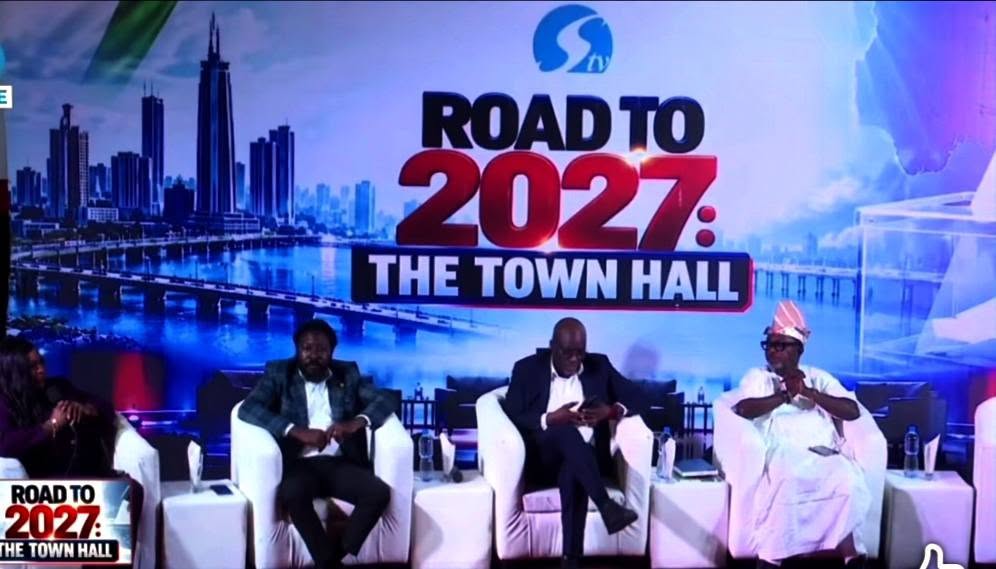
Political economist Pat Utomi and political commentator Segun Sowunmi clashed during Silverbird’s Road to 2027 Town Hall after Utomi was asked why Nigerians should vote for former Anambra State Governor Peter Obi.
The exchange took place on Wednesday, October 21, 2026, as political figures and commentators discussed issues ahead of the 2027 general election.
The question prompted a heated discussion about leadership, corruption, accountability and the effectiveness of Nigeria’s anti-corruption institutions.
Utomi defended Obi by pointing to his record in public office and arguing that Nigeria’s biggest problems stem from corruption and a crisis of values. However, Sowunmi challenged his argument, questioning the effectiveness of the anti-corruption framework Utomi helped develop.
Pat Utomi Defends Peter Obi, Blames Nigeria’s Crisis on Corruption
During the discussion, Utomi argued that Obi’s record in public office offered Nigerians an example of the leadership he could provide.
He criticised what he described as a contradiction between government spending and the demands placed on citizens to endure economic hardship. He specifically questioned the purchase of new presidential aircraft while Nigerians were being asked to tighten their belts.
Utomi also argued that corruption remained a major obstacle to Nigeria’s progress, despite efforts to establish institutions designed to tackle the problem.
He recalled chairing a panel set up by former President Olusegun Obasanjo in 1999 to develop anti-corruption institutions, including the Economic and Financial Crimes Commission (EFCC).
According to Utomi, the panel included the Inspector-General of Police, representatives of the organised private sector and General Isola Williams.
He maintained that the country had developed strategies to tackle corruption but had failed to achieve the intended results.
Utomi further argued that Nigeria’s political elite had prioritised personal interests over the welfare of ordinary citizens.
He said his work on governance and development had focused on finding practical solutions to the challenges facing Nigerians.
Segun Sowunmi Questions Effectiveness of EFCC
Sowunmi challenged Utomi’s defence of the anti-corruption framework, arguing that the failure of an institution to deliver results should prompt its architects to reconsider its structure.
He questioned whether the EFCC’s design adequately addressed the requirements of effective policing, particularly the collection of evidence needed to secure convictions.
Sowunmi suggested that if the institution had failed to achieve its intended goals, those involved in designing its framework should acknowledge the shortcomings.
Utomi pushed back against the criticism, questioning Sowunmi’s position in the debate.
The exchange became more heated when Utomi described Sowunmi as a government mouthpiece. Sowunmi rejected the characterisation and argued that he was not part of the government.
The two continued exchanging remarks as the discussion moved beyond Obi’s record to broader questions about political accountability and the performance of public institutions.
Town Hall Debate Shifts to Political Credibility
The disagreement also touched on the credibility of political arguments and the role of public figures in national conversations.
Utomi maintained that Nigeria needed a fundamental change in values and governance to address corruption and improve the lives of ordinary citizens.
Sowunmi, however, insisted that people who helped design public institutions should be prepared to explain why those institutions had not delivered the expected outcomes.
Their exchange highlighted competing approaches to discussing Nigeria’s leadership challenges: one focused on values and the conduct of the political elite, and the other on institutional design, accountability and measurable results.
Although the discussion began with a question about why Nigerians should vote for Peter Obi, much of the exchange centred on corruption, the EFCC and the responsibilities of those who have influenced public policy.
The encounter has added another moment of political debate to the conversations unfolding ahead of the 2027 elections.
Read Also:2027: Obi Says Fuel Subsidy Will Return After Corruption Crackdown