


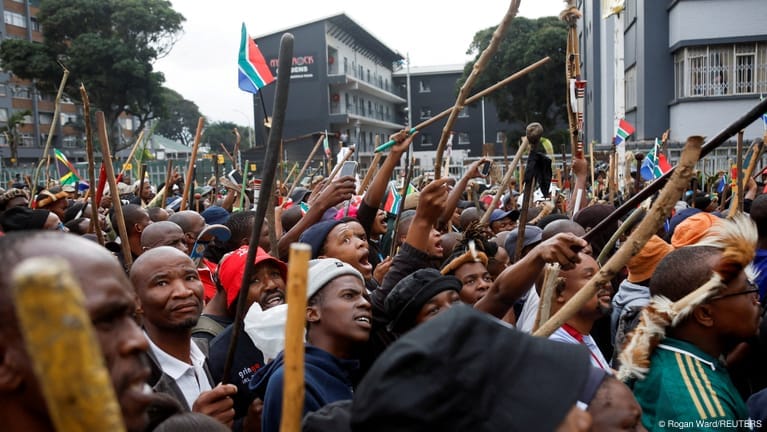
Tensions over the presence of Nigerians in South Africa have escalated after protesters marched through Pretoria, demanding that the government stop Nigerians from entering the country.
The demonstration took place on Wednesday, November 18, 2026, with participants accusing Nigerian nationals of drug trafficking and worsening social problems in local communities.
The protesters, operating under the March and March movement, called for tougher immigration restrictions and the deportation of undocumented foreign nationals.
Led by the group’s leader, Jacinta Ngobese-Zuma, the march took a confrontational turn in Sunnyside, a Pretoria suburb with a sizeable Nigerian community. The area is sometimes referred to as “Little Lagos”.
Ngobese-Zuma challenged Nigerians living in the neighbourhood to explain how the area acquired the nickname and questioned their perceived influence in the community.
She asked who had given Nigerians permission to identify parts of South African territory with Lagos or Nigeria.
Her comments reflected the increasingly hostile language directed at Nigerian residents during the protest.
Protesters demand tougher immigration restrictions
Ngobese-Zuma described the current situation as unsustainable, alleging that migrants were putting additional pressure on public resources and increasing frustration among South African citizens.
The movement said it planned to submit its demands to the Department of Home Affairs.
Its demands include stricter immigration controls, restrictions on refugee admissions and faster deportation of foreigners without valid immigration documents.
The group’s legal representative, Xolani Zuma, also called for a complete ban on Nigerians entering South Africa.
He claimed the proposed restriction was necessary to stop Nigerians from selling drugs to South Africans, while insisting that the movement did not oppose other African nationals.
The protesters further urged the government to withdraw from the 1951 United Nations Convention Relating to the Status of Refugees, arguing that its obligations had become difficult to sustain.
Nigeria and South Africa face fresh diplomatic tensions
The protest comes amid strained relations between Nigeria and South Africa over xenophobic hostility, the safety of Nigerian citizens and recent diplomatic disagreements.
Last week, Nigeria’s High Commissioner to South Africa, Femi Fani-Kayode, exchanged words with the South African Presidency after officials excluded his prepared speech during the presentation of his credentials.
Fani-Kayode described the omission as disrespectful to Nigeria. However, he later said the disagreement had been resolved following the intervention of South African President Cyril Ramaphosa.
He also received an invitation from South Africa’s Department of International Relations and Cooperation.
The Nigerian envoy said he had started addressing concerns affecting Nigerians in the country since taking office.
He described those responsible for xenophobic attacks as a small minority who should not be allowed to represent the wider South African population.
Fani-Kayode maintained that most South Africans were decent and welcoming. He expressed confidence that both countries could resolve their differences without damaging their longstanding diplomatic relationship.
Fani-Kayode warns against attacks on Nigerians
Despite expressing optimism about diplomatic relations, the high commissioner warned that patience was running out within Nigeria’s government over repeated attacks on its citizens.
He stressed that Nigeria would not abandon its nationals to xenophobic violence.
The latest protest adds to concerns over the safety of Nigerians living in South Africa and the potential impact of anti-immigrant campaigns on relations between the two African countries.