
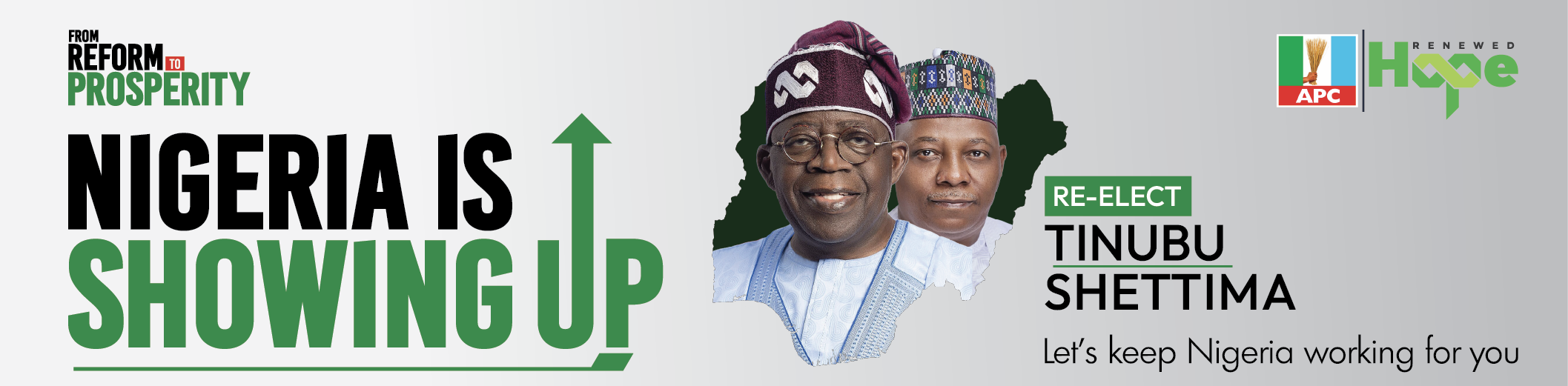


President Bola Tinubu has defended his administration’s borrowing strategy, arguing that loans should fund productive infrastructure projects capable of generating economic growth, creating jobs and improving living standards.
In an article titled From Reforms to Delivery: Our Infrastructure Investment and Growth Strategy, Tinubu said Nigeria had taken difficult economic decisions since 2023 to restore stability and strengthen public finances.
He listed the removal of petrol subsidy, exchange rate unification, tax reforms and coordinated efforts to control inflation among the major steps taken by his administration.
According to the President, these measures have helped restore macroeconomic stability, quadruple federation revenue since 2021 and improve the country’s financial position.
Tinubu said Nigeria’s real Gross Domestic Product (GDP) grew by 4.43 per cent in the second quarter of 2026, while growth for the first half stood at 4.2 per cent. He compared this with 2.74 per cent growth recorded in 2023.
He also stated that headline inflation dropped to 14.63 per cent in September 2026 from 20.98 per cent in the corresponding period of the previous year. Food inflation, however, remained higher at 19.59 per cent.
The President added that Nigeria’s gross external reserves reached $55.1 billion as of October 9, 2026, including approximately $46 billion in net reserves.
He described the reserve position as an 18-year high and said the exchange rate at the Nigerian Foreign Exchange Market stood at ₦1,333 to the dollar, with the gap between markets below five per cent.
Tinubu also argued that Nigeria’s borrowing costs and country risk premium had declined, creating room for the government to secure more favourable financing.
Tinubu Explains New Infrastructure Investment Strategy
The President said his administration was changing the purpose of public borrowing, moving away from using loans mainly to cover short-term fiscal gaps.
Instead, he wants new borrowing directed towards productive assets such as roads, ports, railways and electricity infrastructure.
Tinubu maintained that such projects would generate economic value, increase government revenue and create employment opportunities over several decades.
He said every naira and dollar borrowed should support assets capable of producing returns that justify the debt.
According to him, this approach forms part of Nigeria’s ambition to build a $1 trillion economy by 2030 through investment, industrial growth and higher productivity rather than increased consumption.
He also cited improvements in government revenue and trade figures as evidence of a stronger fiscal position.
Tinubu said Nigeria’s tax-to-GDP ratio had increased to 12.5 per cent from seven per cent. Net allocations from the Federation Account Allocation Committee (FAAC) also rose by 44 per cent, from ₦15.2 trillion in 2024 to ₦21.9 trillion in 2025.
He added that the country recorded a ₦20.1 trillion trade surplus in the first half of 2026, almost twice the ₦10.2 trillion recorded during the same period in 2025.
The President acknowledged that public debt stood at 35.75 per cent of GDP in the second quarter of 2026. He also put debt servicing at approximately 65 per cent of government revenue in the first half of the year.
He said these figures made fiscal discipline essential as the government increased infrastructure spending.
Tinubu further stated that the Federal Executive Council’s economic strategy ruled out deficit monetisation and unfunded commitments during the pre-election period.
Major Projects Targeted for Infrastructure Investment
Tinubu identified several major projects that his administration intends to support through productive borrowing.
They include the Lagos-Calabar Coastal Highway, Sokoto-Badagry Superhighway, Trans-Sahara Superhighway, electricity sector improvements and upgrades to major commercial ports in Lagos.
He also listed hospital rehabilitation, education and vocational training among the areas receiving attention.
According to the President, these projects will connect economic regions, improve access to markets, support agriculture and industry, reduce transportation costs and attract private investment.
He said the projects could create hundreds of thousands of direct and indirect jobs over time.
Tinubu pointed to progress on the Lagos-Calabar Coastal Highway as evidence of ongoing implementation. He said that, as of August 2026, Lot 2 was more than 80 per cent complete, while construction works between Calabar and Akwa Ibom had exceeded 30 per cent.
He also noted that state governments were increasing their investment in capital projects. According to him, the share of state spending allocated to capital expenditure rose from 46 per cent in 2023 to 61 per cent in 2025.
The President argued that infrastructure development would reshape Nigeria’s economic geography by connecting farms, factories, businesses and communities.
Tinubu Highlights Expected Jobs and Economic Benefits
The President said the government would assess major infrastructure projects based on their contribution to economic growth and the value they generate for every naira spent.
He described the Lagos-Calabar Coastal Highway as an important example, saying it could reduce logistics costs along the route by 15 to 20 per cent.
Tinubu also said the project could contribute up to two per cent to Nigeria’s GDP through industrial development, trade and tourism.
He projected that the highway could generate approximately 100,000 direct jobs in construction and engineering, alongside more than 150,000 indirect jobs in logistics, building materials and related services.
He said similar benefits could emerge along the Sokoto-Badagry and Trans-Sahara corridors, as well as through investments in electricity, ports, railways and social infrastructure.
According to him, lower transportation costs could help reduce food prices, improve export competitiveness and increase government revenue.
Tinubu maintained that the economic benefits of the projects would continue long after construction ends.
Government Targets Longer-Term Infrastructure Financing
Tinubu said Nigeria was adjusting its debt structure to match the long lifespan of the infrastructure projects it finances.
He explained that the government was moving away from short-term borrowing towards longer-term financing arrangements with extended repayment periods and lower costs.
The President argued that infrastructure expected to serve the country for 40 years should not depend entirely on short-term loans.
He also said international investors were increasingly willing to commit funds to Nigeria over periods of 10, 15 years and beyond.
On monetary policy, Tinubu cited the 350-basis-point reduction in the Monetary Policy Rate on September 22, 2026, from 26.5 per cent to 23 per cent.
However, he acknowledged that lending rates remained above 30 per cent, making access to affordable long-term financing important for productive investment.
Tinubu Points to Improved International Confidence
The President also highlighted what he described as growing recognition of Nigeria’s economic reforms by international financial institutions and investors.
He said the three major credit rating agencies had taken positive actions on Nigeria’s credit profile.
Tinubu noted that S&P upgraded Nigeria’s sovereign rating to B on May 15, 2026, with a stable outlook. He added that Fitch rated the country B with a positive outlook as of October 9, 2026, while Moody’s maintained a B3 rating with a positive outlook.
He also cited FTSE Russell’s restoration of Nigeria to Frontier Market status and the country’s removal from the Financial Action Task Force (FATF) grey list.
According to the President, Nigeria’s exit from the FATF grey list in October 2025 and the European Union list in January 2026 reflected progress in financial transparency and regulatory compliance.
Tinubu further pointed to the country’s successful Eurobond issuance as evidence of renewed interest from international investors.
He said these developments could improve Nigeria’s access to international capital, attract more institutional investors and help the government secure longer-term financing at lower costs.
The President stressed that the international assessments were not political endorsements but independent evaluations of Nigeria’s economic and financial position.
Tinubu Urges Nigeria to Convert Investor Confidence into Results
Tinubu said international investors, banks and development institutions were increasingly viewing Nigeria as an opportunity for infrastructure investment.
He listed roads, railways, electricity, water, agriculture, transportation and social infrastructure among the sectors that could attract long-term financing.
However, he warned that the country must use the opportunity to deliver projects rather than allow infrastructure delays to undermine economic growth.
According to him, postponing major projects could result in lost investment, higher logistics costs and employment opportunities that never materialise.
The President identified five priorities approved by the Federal Executive Council for the next stage of the government’s economic agenda.
They include food affordability and energy price stability; budget harmonisation and fiscal discipline; completion of major projects and investment in critical infrastructure; improved economic policies and regulatory efficiency; and targeted household support alongside investment in human development.
He said the reforms introduced since 2023 were not intended merely to stabilise the economy but to unlock its productive potential and create lasting prosperity.
Tinubu maintained that the next phase must focus on completed projects and measurable improvements in people’s lives rather than policy announcements alone.
President Insists Borrowing Must Deliver Long-Term Value
Reiterating his administration’s position, Tinubu said Nigeria was moving from borrowing to cover fiscal gaps towards borrowing to expand the country’s productive capacity.
He argued that the central issue should not be the amount borrowed alone but the projects financed, the value created and the opportunities left for future generations.
The President said Nigeria could not build a $1 trillion economy with infrastructure designed for a much smaller economy.
He described the government’s ambition as investing in infrastructure that would serve the country for the next 50 years.
Tinubu also stressed that policymakers must consider the economic cost of delaying projects, including lost employment, investment and business opportunities.
He said roads, railways, ports and electricity infrastructure must work together to connect markets, support industries and improve Nigeria’s competitiveness.
The President added that access to international financing should translate into productive investment, job creation and better living standards.
He also emphasised accountability, saying every naira borrowed must be justified by the economic value it creates.
Tinubu concluded that securing financing was only the beginning, insisting that the real measure of success would be the completion of projects and their impact on Nigerians.
He said his administration’s ambition was to build a $1 trillion economy through infrastructure, industrialisation, trade and improved productivity, while ensuring that future generations benefit from responsible investment.