


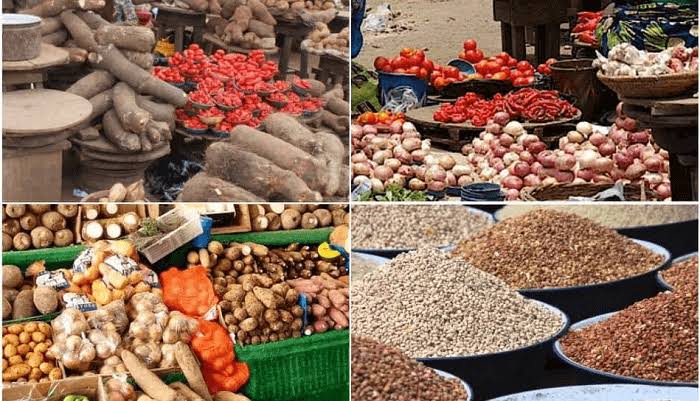
Food prices in Nigeria remain stubbornly high despite Federal Government interventions and the ongoing harvest season, as rising transport costs, insecurity, poor storage and disruptions in agricultural production continue to affect supplies.
Farmers, traders, agribusiness operators and consumers say increased production alone cannot guarantee affordable food. Produce must also reach markets on time, survive storage and transportation, and remain available between harvest seasons.
The challenges have become particularly visible in Lagos markets, where prices of staples such as onions and tomatoes have fluctuated sharply in recent months.
Food Prices Remain High Despite Government Support
President Bola Tinubu’s Renewed Hope Agenda promised to improve food security, boost local production and reduce Nigeria’s reliance on imported food.
In 2023, the Federal Government declared a state of emergency on food security and announced plans to invest ₦200 billion in cultivating 500,000 hectares of farmland. The programme also included distributing fertiliser, seedlings and other farm inputs.
The government has since introduced additional measures to support farmers and expand agricultural production.
In June 2026, the National Agricultural Development Fund launched a programme to distribute 515,720 bags of fertiliser to 128,930 smallholder farmers across 25 states and the Federal Capital Territory.
However, farmers’ organisations say these interventions have not consistently reached the people who need them most. They also question whether the support has translated into lower prices for consumers.
Read Also:nigeria-gas-resources-jobs-export-growth
NBS Data Show Mixed Food Inflation Trends
Figures from the National Bureau of Statistics’ September 2026 Consumer Price Index report show that year-on-year food inflation stood at 19.59 per cent. This was slightly above August’s 19.57 per cent but below the 20.16 per cent recorded in September 2025.
On a month-on-month basis, the food index fell by 1.55 per cent in September after rising by 1.02 per cent in August.
The figures indicate some monthly relief, but they do not mean food prices have returned to previous levels.
Lagos recorded the highest year-on-year food inflation at 34.40 per cent, followed by Imo at 33.79 per cent and Ondo at 31.49 per cent.
By contrast, Taraba recorded negative food inflation of 7.47 per cent, while Borno and Yobe recorded negative rates of 2.18 per cent and 0.37 per cent, respectively.
A market survey at Mile 12 International Market in Lagos also revealed sharp price changes between August and October.
A large basket of tomatoes that sold for ₦65,000 to ₦80,000 in August fell to ₦60,000 at the end of September. By October, the price had climbed to ₦70,000.
Onions recorded an even steeper increase. A large sack sold for ₦130,000 in August, rose to ₦250,000 at the end of September and reached ₦350,000 in October.
Fresh pepper, however, became cheaper. A small bag fell from ₦40,000 in August to ₦25,000 in September and ₦12,000 in October.
Yam prices also dropped following the arrival of new harvests. A tuber that sold for ₦7,000 in August fell to ₦4,000 in September.
Farmers Blame Fuel Costs, Insecurity and Poor Roads
Deputy National President of the All Farmers Association of Nigeria, Daniel Okafor, attributed high food prices partly to expensive fuel and poor rural roads.
He said these challenges increase the cost of transporting agricultural produce from farms to markets.
Okafor, who also heads the Potato Farmers Association of Nigeria, said insecurity in some farming communities disrupts cultivation and the movement of food supplies.
He called for better rural roads, improved security, irrigation facilities, timely farm inputs and farmer training.
According to him, agricultural support must reach farmers in line with the planting calendar to deliver meaningful results.
Acting National President of the Smallscale Women Farmers Organisation in Nigeria, Florence Ojo, also criticised delays and gaps in the distribution of farm inputs.
She said the government should work with farmers’ organisations to identify genuine smallholder farmers and ensure that fertiliser and other support reach them before planting begins.
Ojo also called for improved extension services, better storage facilities and stronger measures to reduce insecurity and post-harvest losses.
Onion Crisis Pushes Prices Higher
The National President of the National Onion Producers, Processors and Marketers Association of Nigeria, Aliyu Maitassamu Isah, identified a seed crisis, warehouse fires and post-harvest losses as major reasons behind soaring onion prices.
He said a seed introduced from Algeria during the 2024–2025 growing season proved unsuitable for Nigeria’s farming conditions.
According to Isah, the disruption caused substantial losses across the onion sector. He said the association estimated the losses at nearly ₦100 billion and reported the problem to the government.
The sector reportedly received about ₦2 billion in support from the Nigerian Agricultural Development Fund. Isah, however, considered the amount inadequate compared with the scale of the losses.
He said the crisis was compounded by inadequate storage facilities and fires that destroyed onions kept in local warehouses.
Isah estimated that more than 51 per cent of the onion supply was lost between April and October.
He argued that the problem was not simply a lack of production. Instead, significant losses reduced the quantity available to consumers before the next harvest arrived.
The association expects fresh supplies from Sokoto around November and December, followed by Aliero in Kebbi State from late December to January. The main harvest is expected around March and April next year.
Isah expressed hope that new supplies would ease prices, while stressing that timely intervention and better storage remained essential.
Seasonal Production Changes Affect Tomato Prices
The National Secretary of the National Tomato Growers, Processors and Marketers Association of Nigeria, Sani Danladi Yadakwari, said the current increase in tomato prices reflects a transition between harvest seasons.
He explained that wet-season supplies were running low while farmers had only begun preparing land and planting for the dry season.
According to him, fresh supplies could begin arriving around late December or January.
Yadakwari also said some farmers reduced production after suffering losses last year when market prices failed to cover their investments.
He noted that farm-gate prices had recently changed, with a crate of tomatoes selling for between ₦16,000 and ₦17,000, depending on freshness. The previous week, the price had reached ₦20,000.
He added that the sector still lacked enough industrial buyers, known as off-takers, to provide dependable demand for farmers’ produce.
The uncertainty, he said, has discouraged some growers from investing as much in production as they did previously.
Traders Say Transportation and Spoilage Increase Costs
Food sellers in Lagos said higher transportation expenses, fuel prices and produce spoilage continue to push up the prices consumers pay.
Caroline Ani, founder of Food Drum, said transporting food from northern Nigeria to Lagos and moving it within the city had become increasingly expensive.
She explained that the cost of moving goods from a Lagos arrival point to other parts of the city could rival the cost of transporting them from Kaduna.
Tomato seller Adeola Adeoye said suppliers now charge more, while spoilage leaves traders with additional losses.
She explained that sellers must raise prices to cover higher purchasing and transportation costs and avoid operating at a loss.
Onion seller Shukurat Eniola also cited limited availability and rising supply costs. She said customers who previously bought onions in large quantities now purchase smaller amounts because of the prices.
Other traders pointed to higher labour and processing expenses affecting commodities such as melon seeds and ogbono.
Consumers Struggle to Afford Everyday Food
The rising cost of food has forced many households to reduce their purchases, even when they spend amounts that previously covered several meals.
A consumer, Amina Bunu, told a reporter at Ijeh Market in Ikoyi that ₦5,000 could no longer buy enough onions for two pots of food.
She said her employer had repeatedly complained about the quantity she brought home, despite the increase in market prices.
Another consumer, Nelson Oche, said spending more than ₦50,000 on food items no longer allowed him to stock his home as he once could.
Oche, who lives with his younger brother, said the amount had previously covered a wider range of household food needs. He now struggles to make it last even two days.
Their experiences reflect the pressure high food prices place on household budgets, particularly when prices fluctuate without returning to earlier levels.
Stakeholders Seek Better Storage and Distribution
Agribusiness stakeholders say Nigeria needs more investment in cold storage, aggregation centres and transport infrastructure to reduce post-harvest losses.
They argue that food should not be wasted after harvest while consumers face shortages and high prices.
Babatunde Niran-Aluko, managing director of Mystrose Agro Commodities Limited and Novachill, said Nigeria had a significant shortage of long-term storage facilities for perishable produce.
He said the gap presents an opportunity for private investment, particularly in cold-chain logistics that can preserve food from collection through transportation and delivery.
Princess Kemdi Chika-Okafor, founder of Century 21 Foundation, advocated decentralised cold-storage facilities near farms, aggregation centres and markets.
She said solar-powered storage hubs could allow farmers and traders to pay only for the space they need. Partnerships with public institutions and non-governmental organisations could also help reduce financing costs.
City Distro founder Olamide Olabisi identified multiple transport levies as another factor driving up food prices.
He said truck operators moving produce from northern states to Lagos often face demands for payments at different local government areas.
Olabisi called for better enforcement of a uniform levy system. He also highlighted farmer-herder clashes and inadequate irrigation as challenges affecting agricultural production.
Sanusi Warns Against Overreliance on Food Imports
The Emir of Kano, Muhammadu Sanusi II, warned that government measures to lower food prices should not undermine local agricultural production.
Speaking at an event in Lagos, he recalled that opening the market to rice imports from countries such as Thailand and India helped reduce prices but also hurt domestic rice mills.
He said some investors in the agricultural value chain were left with bad debts as a result.
Sanusi argued that although imports can provide short-term relief, excessive reliance on foreign food supplies could weaken domestic production and discourage investment.
He urged Nigeria to strengthen its own agricultural capacity rather than depend heavily on imports from countries including Thailand, India and China.
The concerns raised by farmers, traders and agribusiness stakeholders suggest that food prices in Nigeria depend on more than the volume harvested. Lower transport costs, reliable farm inputs, better security and storage, and stronger distribution networks will also be necessary to make food more affordable.