


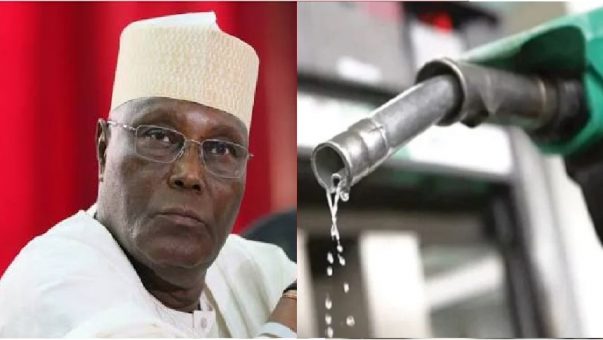
The All Progressives Congress Presidential Campaign Council (APC-PCC) has asked former Vice President Atiku Abubakar to provide details of his proposed production subsidy for locally refined petrol.
The council raised questions about the legal basis, cost and funding of the proposal.
Atiku recently called for lower petrol and diesel prices. He also proposed a production subsidy for locally refined petrol as a way to reduce pump prices.
In a statement issued by its spokesman, Dele Alake, the APC-PCC said the proposal requires clarification under Nigeria’s existing petroleum laws.
APC PCC Cites Petroleum Industry Act
The council referred to Section 205(1) of the Petroleum Industry Act (PIA) 2021.
That section provides for wholesale and retail petroleum prices to operate under unrestricted free-market conditions.
The Nigerian Midstream and Downstream Petroleum Regulatory Authority (NMDPRA) also recently said it does not fix petrol pump prices under the current framework. The regulator said government intervention can occur only under specific conditions provided by law.
The APC-PCC therefore asked Atiku to explain how his proposed subsidy would work within the PIA.
The council wants to know whether refineries that receive government support would have to sell petrol at a specified price.
If such a condition applies, it asked Atiku to identify the legal provision that would support it.
If no such condition applies, the council questioned how the subsidy would guarantee lower prices for consumers.
Questions Over Cost and Funding
The APC-PCC also asked Atiku to disclose the expected cost of the proposal.
According to the council, Atiku’s earlier comments suggested that the government could provide crude oil to domestic refineries at a preferential price.
The council argued that such a discount could reduce government revenue.
It estimated that the proposed intervention could cost between ₦17 trillion and ₦21 trillion annually. However, the council said the figure would depend on the subsidy rate, the volume covered and the structure of the proposed scheme.
The council said Nigerians should receive clear answers on seven areas:
- The proposed subsidy rate.
- The annual spending limit.
- The volume of crude or petrol covered.
- The source of funding.
- The mechanism for passing savings to consumers.
- Measures against diversion, smuggling and fraudulent claims.
- Whether the PIA would require amendment.
It also said a National Assembly appropriation would not automatically resolve regulatory questions under the PIA.
APC PCC Raises Questions Over Atiku’s Previous Position
The council also compared Atiku’s current proposal with his previous position on petrol subsidy.
It recalled that Atiku spoke against the subsidy system at the Lagos Business School in November 2022.
According to the APC-PCC, Atiku described the system as fraudulent and pledged to complete its removal.
The council also referenced a statement Atiku made on August 25, 2026, in which he said, “I will restore it!”
The APC-PCC asked Atiku to explain how his current proposal differs from the previous subsidy arrangement.
It also asked how the proposed system would address concerns linked to smuggling, misuse and public spending.
Council Highlights Alternative Transport Programmes
The APC-PCC said the Tinubu administration has focused on other measures to reduce transportation costs.
The council cited compressed natural gas (CNG) and electric buses as examples.
It said more than 120,000 vehicles have undergone CNG conversion, while private operators have also carried out additional conversions.
The statement also cited CNG and electric transport initiatives in several states.
According to the council, commuters in seven states and the Federal Capital Territory have recorded fare reductions on some routes served by CNG and electric buses.
It cited Borno, Niger, Kaduna, Adamawa and Abia among the states involved in the programmes.
The council said Kaduna’s free CNG buses transported more than 1.4 million passengers during five months in 2025.
It also said the programme saved passengers an estimated ₦1.39 billion in fares.
APC PCC Points to Domestic Refining
The council also highlighted developments in Nigeria’s domestic refining industry.
It pointed to the Dangote Petroleum Refinery and its reported production capacity.
The Dangote Refinery IPO has also attracted strong market interest as the company seeks fresh capital for expansion.dangote-refinery-ipo-raises-n1-5trn/
The statement said the refinery https://e247mag.com/dangote-refinery-ipo-raises-n1-5trn/has a nameplate capacity of 650,000 barrels per day and reportedly reached 700,000 barrels per day during performance tests.
The council also referenced the refinery’s proposed ₦2.1 trillion initial public offering for expansion.
The Atiku petrol subsidy proposal comes amid continued debate over fuel prices, domestic refining and the future of Nigeria’s downstream petroleum sector.
The NMDPRA recently said market forces determine wholesale and retail petroleum prices under the PIA. It also said the regulator focuses on market regulation, consumer protection and fair competition.
Council Requests More Details
The APC-PCC acknowledged the pressure that higher petrol prices have placed on households and businesses.
However, it said the government should ensure that any intervention remains lawful, transparent and properly costed.
The council urged Atiku to publish a detailed policy document explaining his proposal.
It also requested an independent legal and fiscal assessment of the plan.
The Atiku petrol subsidy proposal, according to the APC-PCC, requires further clarification on its legal framework, funding structure and mechanism for delivering lower prices to consumers.
Atiku and his team have yet to provide the detailed policy framework requested by the council in the statement.
The Atiku petrol subsidy proposal remains part of the wider 2027 political debate over fuel pricing, subsidy policy and the future direction of Nigeria’s downstream petroleum sector.