


Tensions in the ongoing conflict involving the United States, Israel and Iran have intensified as the war entered its fifteenth day on Saturday, with casualties continuing to rise across the region.
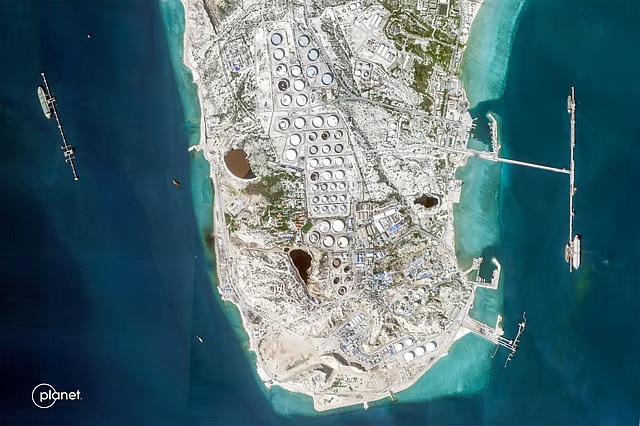
US President Donald Trump announced on Friday that American forces carried out strikes on Kharg Island, claiming that every military target on the island had been “totally obliterated.” The island, located in the Persian Gulf, is considered crucial to Iran’s oil industry as it is believed to manage roughly 90 percent of the country’s crude oil exports.
Trump said the strikes deliberately avoided oil facilities on the island but warned that the United States could target Iran’s energy infrastructure if Tehran attempts to block shipping through the Strait of Hormuz—one of the world’s most important maritime routes for oil transport.
Iran has strongly reacted to the warning, threatening to destroy oil and energy facilities belonging to companies cooperating with the United States if its own energy infrastructure is attacked. Iranian state media reported that the country’s Armed Forces Unified Combatant Command warned that such facilities would be “turned into a pile of ashes” in the event of further escalation.
The secretary of Iran’s Supreme National Security Council, Ali Larijani, also cautioned Washington against targeting Iran’s electricity network. His remarks came after Trump reportedly suggested that Iran’s power system could be disabled within an hour. Larijani warned that any such move would provoke a response capable of plunging the wider region into darkness.
Meanwhile, security concerns increased in Iraq after a missile struck a US helipad near the American embassy in Baghdad. Iraqi authorities confirmed the incident on Thursday following a level-four security alert issued by the United States warning embassy personnel of potential attacks from Iran-aligned militias. Reports indicated smoke rising from the embassy complex inside Baghdad’s fortified Green Zone.
The conflict has also spilled into Lebanon. According to the Lebanese health ministry, Israeli airstrikes launched in retaliation for missile attacks by Hezbollah on March 2 have killed more than 773 people in the country. Among the victims are over 103 children, while nearly 2,000 others have been injured.
In Iran, the death toll from the ongoing war has reached at least 1,444 people, with victims ranging in age from infants to elderly civilians.
Diplomatic efforts are underway to prevent disruption to global energy supplies. Governments in France and Italy have begun discussions with Iran to ensure safe passage for their ships through the Strait of Hormuz. France is also reportedly exploring the creation of an international coalition to safeguard the waterway once the security situation improves.
At the same time, China is negotiating with Iran to allow crude oil shipments and liquefied natural gas cargoes from Qatar to transit the strait safely. Reports suggest Tehran is considering permitting a limited number of tankers to pass through the route if the oil trade is conducted in Chinese yuan.
The war has also taken a toll on US forces in the region. The US military confirmed that six American personnel died after a Boeing KC‑135 Stratotanker refuelling aircraft crashed in western Iraq during an operation known as Operation Epic Fury. The aircraft was used to refuel fighter jets in mid-air.
The US Central Command said the aircraft went down while flying in friendly airspace and insisted that it was not shot down. However, an Iran-linked Iraqi militia group claimed responsibility for bringing the aircraft down.
The latest deaths bring the total number of US soldiers killed in the conflict to 13, including seven who were previously killed in Iranian strikes in Kuwait.
The Strait of Hormuz remains a critical global energy corridor. According to research cited from the CESifo Research Network in Germany, about 6.2 percent of crude oil and 8.7 percent of liquefied natural gas imported from non-EU countries passed through the waterway in 2024.