


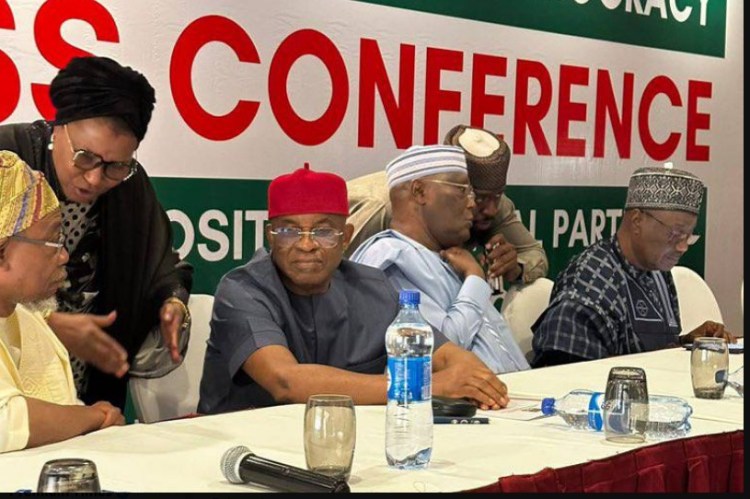
Major opposition leaders have kicked against the newly amended Electoral Act 2026, urging the National Assembly to reopen the legislation and make further changes that, they say, better reflect the aspirations of Nigerians.
At a joint press briefing in Abuja on Thursday, opposition figures described the law as anti-democratic and warned that some of its provisions could undermine the integrity of future elections, particularly the 2027 general polls.
Speaking on behalf of the coalition, the National Chairman of the New Nigeria People’s Party (NNPP), Ahmed Ajuji, criticised the amendment signed into law by President Bola Tinubu on 18 February. He alleged that certain clauses in the Act could weaken transparency in the electoral process and erode public confidence in the system.
Ajuji expressed concern over Section 60(3), which he said gives presiding officers discretionary powers regarding the electronic transmission of results. According to him, the provision could be exploited to delay uploading results to the Independent National Electoral Commission’s (INEC) Results Viewing Portal (IREV), especially under claims of network failure.
He argued that such concerns about connectivity were exaggerated, citing data from the Nigerian Communications Commission indicating widespread 2G coverage across the country. He also referenced remarks by former INEC Chairman Mahmood Yakubu, who had previously stated that the Bimodal Voter Accreditation System (BVAS) functions offline and records high success rates nationwide.
The opposition leaders also rejected Section 84 of the Act, which restricts political parties to direct primaries or consensus in selecting candidates. Ajuji described the move as an intrusion into the internal affairs of political parties and insisted that nomination processes should remain their exclusive prerogative. He maintained that indirect primaries, excluded under the new provision, have previously provided an organised and transparent method of candidate selection.
The coalition further alleged that past experiences with direct primaries had, in some cases, produced questionable vote figures. They pledged to explore all constitutional options to challenge the Act and called on civil society organisations and Nigerians at large to support their efforts.
Beyond the legislation, Ajuji criticised the conduct of recent Federal Capital Territory (FCT) Area Council elections, describing them as indicative of what could happen in 2027 if reforms are not made. He linked declining voter turnout to growing distrust in the electoral system and emphasised the need to restore confidence by ensuring credible elections and tangible democratic dividends.
The opposition also condemned reported attacks on leaders of the African Democratic Congress (ADC) in Edo State, stressing that political disagreements must not lead to violence.
Former Vice President Atiku Abubakar announced that the statement from the briefing would be forwarded to Nigerian embassies abroad, calling for broader support to defend democratic principles. He urged opposition parties to unite in what he described as a shared struggle to safeguard Nigeria’s democracy.
ADC National Chairman David Mark questioned why real-time transmission of results had become contentious and criticised legislative involvement in determining parties’ primary methods. Former Minister of Transportation Rotimi Amaechi similarly urged opposition groups to close ranks, arguing that unity among them was essential.
Peter Obi, the Labour Party’s 2023 presidential candidate who is now aligned with the ADC, echoed the call for cooperation among opposition parties to protect democratic values.
Other notable figures present at the briefing included former Governors Rauf Aregbesola and Liyel Imoke, Senator Ireti Kingibe, NNPP Board of Trustees Secretary Buba Galadima, and former ADC National Chairman Ralph Nwosu.