


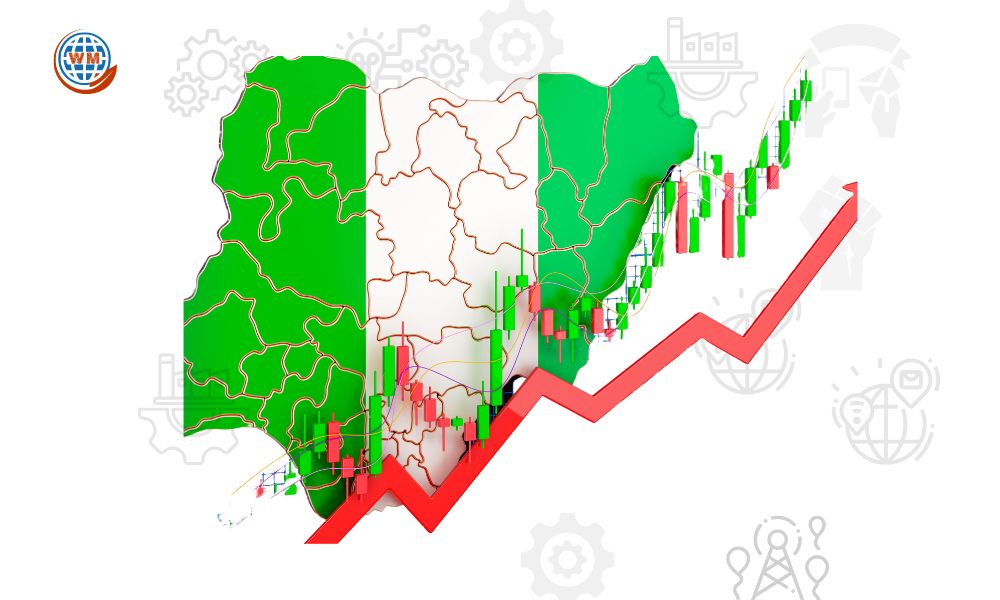
Six decades of structural corruption have built a machine that cannot pump, cannot refine, and cannot account for what it earns — even as Brent trades above $100 a barrel.
There is a moment, in the life of every great squandering, when the world offers you a second chance and you cannot reach out to take it. That moment, for Nigeria, is now.
As American and Israeli strikes reorder the geopolitics of the Persian Gulf, as Strait of Hormuz anxiety sends Brent crude surging past $100 — at moments touching $114 — a nation sitting atop some of the world’s most prized light sweet crude should be counting its windfall. The mathematical case for Nigerian prosperity is irresistible. The political and structural reality is devastating.
Nigeria is not cashing in. Nigeria cannot cash in. And the reason, stripped of euphemism, is corruption — not as metaphor, not as talking point, but as engineering. Decades of deliberate plunder have built infrastructure designed to fail, institutions designed to conceal, and a state designed to serve the few at the expense of the many.
The False Dawn of Improved Security
Begin with what is genuinely true. There has been real progress on pipeline security. In 2025, the Nigerian Army and NNPC reported something that would have seemed fantastical just three years prior: zero pipeline vandalism incidents. Pipeline availability, they claimed, was restored to near 100 percent. This is not nothing. The theft crisis that bottomed out at 960,000 barrels per day in August 2022 — with an estimated 30 percent of all Nigerian oil never reaching its destination — has been partially reversed.
Authorities deserve acknowledgement for that. But here is the problem. Improved pipeline security is a plumber fixing one leaking pipe in a house whose foundation has collapsed. Nigeria’s crude oil production fell to 1.31 million barrels per day in February 2026 , against its own OPEC quota of 1.5 million and a stated national ambition of 2 million or more. The cumulative underproduction for Nigeria between January 2025 and January 2026 amounted to an estimated 18.12 million barrels — translating to $1.31 billion in lost revenues at prevailing prices. Even at the sector’s best recent performance, Nigeria is pumping 1.42 to 1.46 million barrels a day against a government target of 1.84 million. That is a daily shortfall of 380,000 barrels — and with Brent above $100, Nigeria is hemorrhaging $21 million every single day from missed production alone.
Security was never the primary disease. It was a symptom.
Pre-Sold Oil and the Mortgage on Tomorrow
The structural rot runs deeper than any pipeline. Consider what Nigeria is actually earning from the oil it does produce.
Some 272,500 barrels per day — nearly a fifth of all output — is already pledged to service $8.8 billion in crude-backed loans. This oil is sold before it leaves the ground. It belongs, legally and contractually, to creditors. Nigeria pumps it, counts it, and never sees a dollar from it. When Brent rises, those creditors benefit. Nigeria does not.
This is the compound consequence of governance-by-borrowing: the windfalls are encumbered in advance, and the deficits are borrowed against the future. A nation that should be building sovereign wealth funds is instead pre-selling its natural resources to stay liquid.
A Nation That Cannot Refine Its Own Oil
Then there are the refineries. All four of Nigeria’s state-owned refineries are shut down. An oil nation imports its own fuel. This is not an operational problem. It is a moral indictment.
The Port Harcourt, Warri, and Kaduna refineries have consumed, over the decades, billions in so-called turnaround maintenance funds — money that passed through government accounts and vanished. Investigations have found that some facilities were declared “rehabilitated” and invoiced accordingly by contractors who never set foot on site. The refineries remained broken. The money was gone. This was not incompetence. This was design.
The consequence is that Nigeria pays global market prices for refined petroleum products that it could, in a rational world, produce domestically from its own crude. When oil prices rise — as they have risen now, dramatically — fuel import costs rise in tandem. The windfall at the wellhead is partially neutralized at the pump.
Nigeria, despite being an oil producer, has historically depended on imported refined petroleum products. Rising global crude prices typically translate into higher petrol and diesel costs, increasing transportation expenses, manufacturing input costs and food prices — pressures that could fuel inflation and weaken household purchasing power. The very crisis that should be enriching Nigeria is, for ordinary Nigerians, making daily life more expensive.
Infrastructure in Terminal Decline
More than 60 percent of Nigeria’s oil pipelines are beyond their design life. These are not ageing structures in need of maintenance. They are structures that should have been decommissioned and replaced — and were not, because the money allocated for their replacement was stolen.
The consequence is visible in the investment data. Foreign oil companies, once the engine of Nigerian upstream development, have pulled $17 billion from the sector since 2006. Shell, TotalEnergies, Eni — the majors have divested their onshore assets and retreated to deepwater, where the risks of theft and operational disruption are lower. The onshore assets they left behind went to local operators with shallower pockets and, in some cases, shadier governance. Oil theft and pipeline vandalism had long plagued Nigeria’s upstream oil and gas industry, driving majors out of the biggest OPEC producer in Africa.
Nigeria has been struggling to keep up with its production quota under the OPEC deal for years. Last year, the country exceeded its OPEC quota only in January, June, and July, with production falling below the ceiling in all other months of 2025. The steepest deficit occurred in September 2025, when production dropped to 1.39 million barrels per day — some 110,000 bpd below the OPEC quota.
The result: Nigeria missed its OPEC quota for nine of twelve months in 2025. The calculated loss in potential revenue stands at N1.76 trillion — from quotas it set for itself and could not meet.
The Missing Trillions
The Senate uncovered ₦210 trillion in unaccounted NNPC revenues. Read that figure again. ₦210 trillion. Not pilfered petty cash. Not minor discrepancies between departments. One hundred and twenty billion dollars, roughly, in oil revenues that passed through Nigeria’s national oil company and cannot be formally accounted for.
SERAP — the Socio-Economic Rights and Accountability Project — is suing NNPC separately over missing and diverted funds totalling N22.3 billion, $49.7 million, £14.3 million, and €5.2 million across multiple currencies and jurisdictions. These are not allegations. These are the documented findings of Nigeria’s own institutions.
This is what six decades of corruption-as-governance produces. Not merely a few bad actors. A system — a comprehensive, self-sustaining system — in which the extraction of public wealth is normalized, institutionalized, and protected by the very authorities charged with preventing it.
The Arithmetic of Catastrophe
Nigeria could have earned N28.3 trillion extra from this Iran war oil boom. That is the size of the windfall that should have flowed into federal coffers, funded infrastructure, capitalized schools and hospitals, and rebuilt the productive capacity of an economy in which more than 100 million people live below the poverty line.
Instead, the structural rot built over six decades means the windfall slips through fingers before it is ever counted. Every barrel produced is already partially spoken for — by debt service, by committed crude-backed loans, by a refinery sector that does not refine, by pipelines that have exceeded their operational lives, by a national oil company whose accounts cannot be reconciled.
As Dele Oye, the President of the Nigerian Association of Chambers of Commerce, put it with the precision that only lived experience provides: “The paradox is painful: oil is expensive, but our pockets remain empty.”
The Reckoning That Must Come
There is a phrase that haunts every analysis of Nigerian oil revenues: “resource curse.” It is too gentle. Curses are imposed from outside. What has happened to Nigeria was chosen — chosen by each successive government that raided the NNPC, by each contractor who invoiced for work never done, by each official who approved crude-backed loans whose terms were never published, by each administration that protected the thieves rather than prosecuting them.
Nigeria would have hit an economic jackpot if its crude oil production had reached its installed capacity or quota under OPEC, according to Nigerian economists. Instead, the country is producing far below its potential as an oil-producing nation, thereby limiting the benefits it can derive from the current rise in global crude prices.
The Iran war will not last forever. Oil prices will not remain above $100 indefinitely. History has a way of closing these windows with brutal finality — and then, as Nigerian governments have discovered repeatedly, the conversation pivots from windfall to debt restructuring.
Nigeria has been given another chance. There will not be infinite chances.
The question — the only question that matters — is whether anyone with the power to act has the will to act before this window, too, closes forever.
Kio Amachree is President of Worldview International and a Stockholm-based political commentator and diaspora activist.