


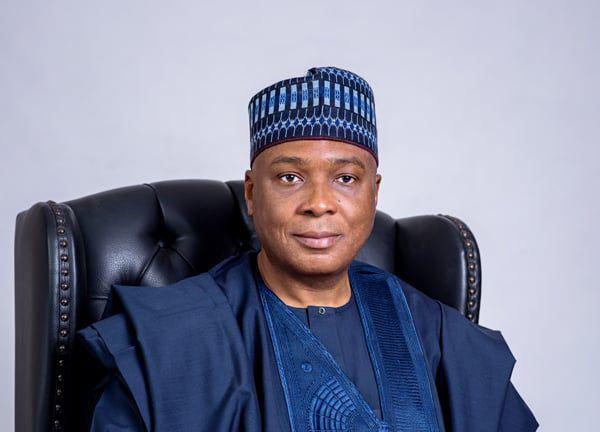
By: Osaze Osa
In politics, consistency is often mistaken for weakness by those who mistake proximity to power for relevance. The recent attempt to paint His Excellency, Senator Bukola Saraki, as a politician undone by duplicity collapses under the weight of facts, history, and context.
Let us be clear: engaging across political divides is not duplicity. It is statesmanship. Senator Saraki is not a member of the ruling APC and owes no one an explanation for maintaining national relationships.
A former Senate President does not retire into partisan isolation; he remains a national asset.
As Senate President from 2015 to 2019, Bukola Saraki presided over the most independent, productive, and reform-driven Senate in Nigeria’s Fourth Republic.
Under his leadership, the legislature asserted its constitutional role, strengthened oversight, and resisted executive overreach. That era remains incomparable to today’s Senate leadership, where legislative independence has largely been replaced by pliancy. Any attempt to equate Saraki’s tenure with what is currently obtainable is not analysis — it is revisionism.
One of the most consequential, yet conveniently forgotten, moments of Saraki’s leadership was his principled resistance to policies that threatened Nigeria’s fragile unity. During the Buhari presidency, Saraki was among the few national leaders who openly cautioned against the Muslim–Muslim political configuration, warning of its long-term implications for national cohesion.
That position was not politically convenient, but it was statesmanlike — placing national balance above personal ambition.
Those who now accuse Saraki of lacking courage should explain why they were silent when such difficult conversations needed brave voices.
The claim that Saraki is isolated within the PDP is equally hollow. History tells a different story. Former Senate Presidents Pius Anyim and David Mark eventually left the party. Former Vice President Atiku Abubakar once exited the PDP as well. Many who wore the party’s colours at critical moments chose personal exits when the pressure mounted.
Even Governor Seyi Makinde, now cited as a benchmark of relevance, was a central figure in the G5 episode that openly worked against the PDP’s presidential candidate in the 2023 election. That episode remains one of the most damaging internal betrayals in the party’s history.
Saraki, by contrast, stayed.
In 2019, at a critical moment when Atiku Abubakar faced diplomatic and political headwinds, it was Saraki’s leadership and credibility that helped secure him a soft landing to travel to the United States — an intervention that altered the trajectory of that campaign. That is not the action of a distrusted or irrelevant politician; it is the mark of a trusted institutional figure.
While others defected, negotiated personal deals, or undermined the party from within, Saraki remained a stabilising backbone of the PDP. He chaired reconciliation efforts, absorbed political blows, and placed party survival above ego.
Remaining when others leave requires more conviction than leaving when things get tough.
Comparisons with Senator Godswill Akpabio also betray a shallow understanding of political leadership. Alignment with power is not the same as leadership of institutions. Saraki’s Senate strengthened democracy; today’s legislature struggles to assert independence. History will remember that difference.
Saraki’s critics speak of cleverness and arrogance. But politics does not only reward alignment; it also rewards courage, foresight, and the willingness to stand alone when principles demand it.
Today, Bukola Saraki remains standing with the PDP — not because it is easy, but because consistency is his political currency. And in a political culture where defection has become the norm, standing firm has become the rarest form of leadership.
History is indeed unforgiving.
But when the dust settles, it will remember who stayed, who fled, and who stood for institutions over convenience.
Osaze Osa
writes from Abuja